WeaveBench: A Long-Horizon, Real-World Benchmark for Computer-Use Agents with Hybrid Interfaces





A benchmark for computer-use agents that weave GUI and CLI/code together in real deployed runtimes. 114 long-horizon, real-world tasks across 8 work domains, each requiring the agent to interleave GUI observation with CLI/code execution in one trajectory, scored by a trajectory-aware Agent-as-Judge that reads the full chat trace + deliverables and zeroes fabricated evidence. The best frontier pairing clears just 41.2% — far from saturation.
- 2026-07-08 🧵 Per-case agent trajectories released — browse the best hybrid GUI+CLI rollout for every one of the 114 tasks (thinking · actions · screenshots · deliverables · judge scores), bilingual viewer. Trajectory gallery
- 2026-06-30 🚀 OSWorld-V2 hybrid GUI+CLI harness — GPT-5.5 gains +5.5 pt Binary (13.0→18.5%) at ~2× tool-call efficiency.
experiments/osworld_v2_hybrid/ - 2026-06-12 🎉 Ranked #4 on HF Daily Papers with 104 upvotes.
- 2026-06-08 Initial preprint + project website live.
- 2026-06-06 🔬 OSWorld CLI-agent re-judge — an in-VM agent-as-judge recovers CLI successes the GUI grader misses (~2× more efficient than vision).
experiments/osworld_hybrid/ - 2026-06-05 🔥 WeaveBench released — 114 channel-non-substitutable tasks, 8 domains, trajectory-aware agentic judge; 9 backbones × 4 runtimes, best pairing 41.2% PassRate.
docs/REPRODUCE.md
Want your model on the board? See Submit your results.
What — 114 long-horizon tasks across 8 domains (WEB, DAV, OPS, DOC, DES, GAM, SPA, DSK), sourced from real user requests with traceable provenance.
The twist — Each task is channel-non-substitutable: no single-channel rewrite can solve it. GUI exposes transient rendered state (canvas, dialogs, charts); CLI/code carries persistent state (configs, logs, services). You need both, woven together.
Scoring — A trajectory-aware agentic judge re-fetches evidence over multiple turns and zeros any rollout with high-confidence fabrication (synthetic screenshots, hard-coded metrics). Outcome-only grading overestimates GPT-5.5 by +20 pts (53.5% → audited 33.3%).
Headline — Best model-runtime pairing (Claude Opus 4.7 + Claude Code) = 41.2% PassRate, vs >78% the same backbones reach on OSWorld-Verified.
https://github.com/weavebench/WeaveBench/raw/main/docs/media/rabbitmq_dlq_demo.mp4
An agent diagnosing a RabbitMQ dead-letter-queue routing black-hole end-to-end (OPS domain, sped up 10×). It cross-checks the broker over the CLI and the Management UI on screen, fixes the binding, and re-verifies — exactly the GUI↔CLI interleaving WeaveBench requires. Can't see the player? Watch the demo here.
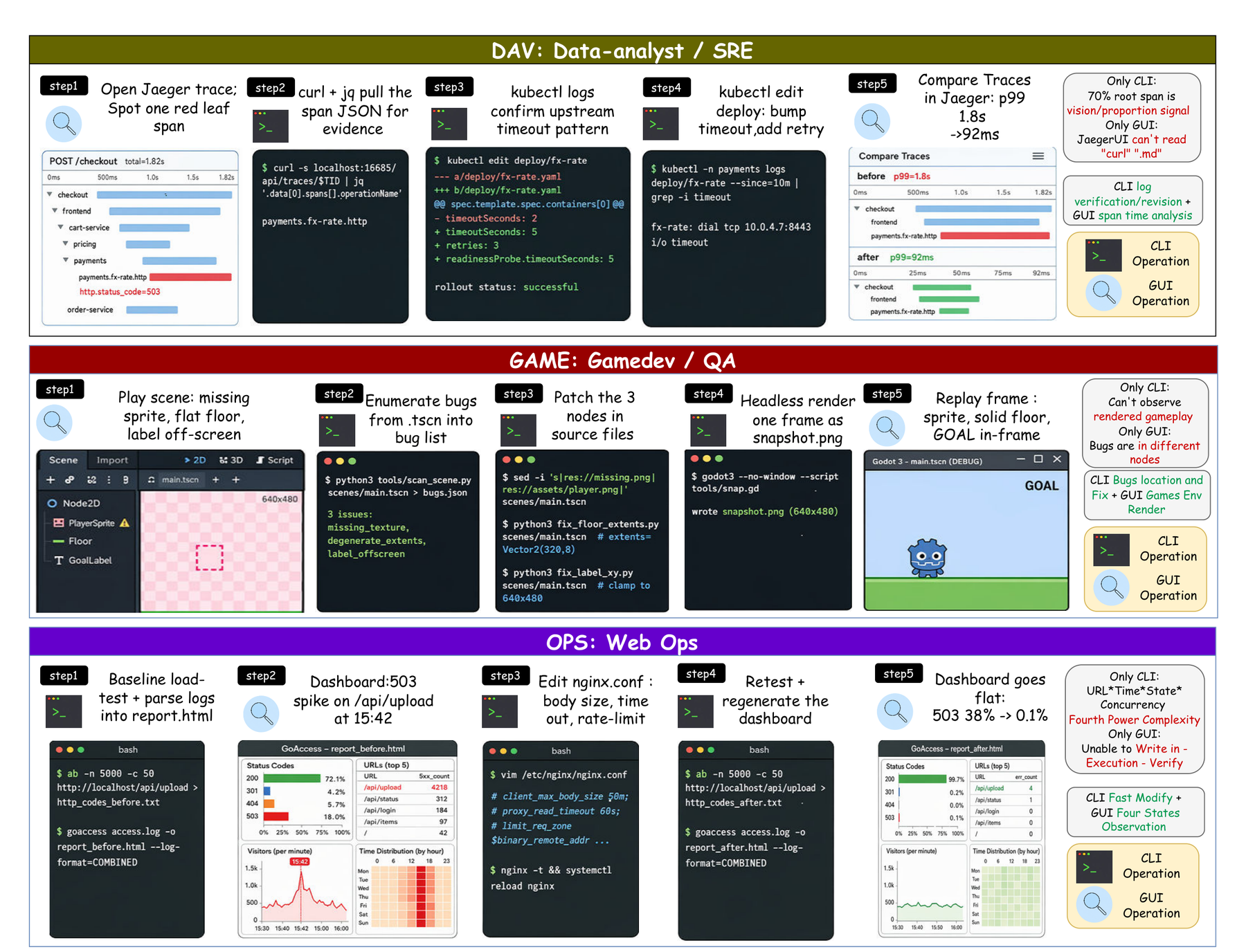
Three more cross-channel workflows at a glance. Browse all task demos on the website.
GUI and CLI/code carry fundamentally different state, so neither suffices alone — GUIs expose transient rendered state (canvases, dialogs, chart tooltips, spatial layout) that no API returns, while CLI/code carries persistent scriptable state (source, configs, logs, services) that no screenshot can produce. WeaveBench admits a task only when success requires weaving the two together (criterion P1 in the paper). That single admission rule is what separates it from prior "multi-interface" benchmarks where the extra channel is a convenience, not a requirement:

Full positioning table + per-task falsifiers in the paper.
Take OPS_task_17_rabbitmq_dlq_topology_mgmt (the demo above). An SRE alert says the orders.dlq dead-letter queue is stuck at depth 0 while ~30% of orders are being nack'd and silently vanishing. The agent must produce a paste-ready post-mortem — and the evidence has to cross-validate two channels.
Why it can't be done from one channel:
| Step | Channel | What happens |
|---|---|---|
| 1. Snapshot the broker | 🖥️ CLI | rabbitmqctl list_queues → orders.dlq depth ≈ 0 but orders.audit keeps growing |
| 2. Dump bindings + queue args | 🖥️ CLI | x-dead-letter-routing-key=dead.unrouted ≠ the binding's literal dead.routed.* — root cause is a routing-key typo a topic exchange won't wildcard-match |
| 3. Visualize the rate gap | 🪟 GUI | Hover the Management UI's Message rates chart so the publish-vs-deliver gap (≥4 msg/s) is readable in a tooltip — a number no JSON dump renders the same way |
| 4. Fix + re-bind | 🖥️ CLI | Write a re-entrant 06_remediation.sh that re-binds orders.dlx → orders.dlq on dead.unrouted |
| 5. Prove the fix landed | 🪟 GUI | Re-screenshot the Overview after ≥10 s — DLQ depth now climbs to ≥20, visible on the live panel |
The judge then checks an explicit cross-channel evidence chain (cross_channel.json: ≥5 channel switches, ≥2 STRUCT: + ≥2 VISUAL: entries). Skip either channel and the score is hard-capped at 0.4 — you cannot pass by dumping JSON alone or by screenshotting alone.
Anti-gaming is built in: text dumps must trace back to real broker queries in the action log (no echo-ing the answer), and screenshots must be real Management-UI renders — a PIL-drawn PNG that satisfies a file-existence check gets zeroed by the judge's VLM rubric.
Every reported model × harness pairing over the full 114-task suite, ranked by PassRate. PR = PassRate (%) at τ=0.80; Overall = mean per-task score. Per-domain columns are PassRate for DSK (Desktop), DOC (Document), GAM (Games), WEB (Web Dev), DAV (Data Analysis & Viz), OPS (DevOps), SPA (Spatial/3D), DES (Design). This board is live — submit your own pairing to be added.
| # | Model | Harness | PR ↑ | Overall ↑ | DSK | DOC | GAM | WEB | DAV | OPS | SPA | DES |
|---|---|---|---|---|---|---|---|---|---|---|---|---|
| 1 | Claude Opus 4.7 | Claude Code | 41.2 | 0.532 | 55.6 | 47.1 | 23.5 | 53.3 | 23.1 | 50.0 | 33.3 | 40.0 |
| 2 | GPT-5.5 | Codex CLI | 35.1 | 0.499 | 38.9 | 29.4 | 23.5 | 53.3 | 15.4 | 50.0 | 58.3 | 10.0 |
| 3 | Claude Opus 4.7 | OpenClaw | 35.1 | 0.482 | 55.6 | 29.4 | 23.5 | 66.7 | 15.4 | 41.7 | 16.7 | 20.0 |
| 4 | GPT-5.5 | OpenClaw | 33.3 | 0.466 | 38.9 | 35.3 | 35.3 | 21.4 | 23.1 | 38.5 | 33.3 | 40.0 |
| 5 | GPT-5.5 | Hermes | 31.6 | 0.466 | 55.6 | 29.4 | 35.3 | 40.0 | 7.7 | 25.0 | 25.0 | 20.0 |
| 6 | Seed 2.1 pro | Claude Code | 30.7 | 0.551 | 44.4 | 41.2 | 17.6 | 40.0 | 30.8 | 8.3 | 33.3 | 20.0 |
| 7 | Seed 2.1 turbo | Claude Code | 28.9 | 0.571 | 38.9 | 35.3 | 17.6 | 33.3 | 30.8 | 16.7 | 33.3 | 20.0 |
| 8 | Claude Opus 4.7 | Hermes | 28.1 | 0.516 | 33.3 | 47.1 | 11.8 | 26.7 | 30.8 | 50.0 | 8.3 | 10.0 |
| 9 | GPT-5.4 | OpenClaw | 22.8 | 0.465 | 55.6 | 35.3 | 5.9 | 0.0 | 23.1 | 23.1 | 8.3 | 20.0 |
| 10 | GPT-5.3-codex | OpenClaw | 18.4 | 0.456 | 33.3 | 23.5 | 29.4 | 0.0 | 7.7 | 16.7 | 8.3 | 20.0 |
| 11 | GPT-5.5 | Claude Code | 14.9 | 0.299 | 33.3 | 11.8 | 11.8 | 0.0 | 15.4 | 16.7 | 25.0 | 0.0 |
| 12 | Claude Opus 4.7 | Codex CLI | 13.2 | 0.378 | 16.7 | 11.8 | 11.8 | 6.7 | 7.7 | 25.0 | 16.7 | 10.0 |
| 13 | GPT-5.2-codex | OpenClaw | 6.1 | 0.321 | 5.6 | 11.8 | 0.0 | 0.0 | 15.4 | 16.7 | 0.0 | 0.0 |
| 14 | GPT-5.1-codex | OpenClaw | 1.8 | 0.226 | 0.0 | 5.9 | 0.0 | 0.0 | 7.7 | 0.0 | 0.0 | 0.0 |
| 15 | Gemini 3.1 Pro | OpenClaw | 1.8 | 0.223 | 0.0 | 0.0 | 0.0 | 0.0 | 0.0 | 8.3 | 8.3 | 0.0 |
| 16 | Qwen3.5-397B-A17B | OpenClaw | 0.9 | 0.318 | 0.0 | 0.0 | 0.0 | 0.0 | 0.0 | 8.3 | 0.0 | 0.0 |
| 17 | Qwen3-VL-8B-Think | OpenClaw | 0.9 | 0.092 | 0.0 | 0.0 | 0.0 | 0.0 | 8.3 | 0.0 | 0.0 | 0.0 |
| 18 | GUI-Owl-1.5-32B | OpenClaw | 0.0 | 0.065 | 0.0 | 0.0 | 0.0 | 0.0 | 0.0 | 0.0 | 0.0 | 0.0 |
Two findings the numbers make concrete: (1) frontier backbones report >78% on OSWorld-Verified — WeaveBench is far from saturation; (2) runtime alignment matters as much as the model — the same GPT-5.5 API swings 20 pts (35.1% on Codex CLI → 14.9% on Claude Code). The two most GUI-heavy domains (SPA, DES) are the bottom of the table for nearly every backbone, pinning the GUI side as the binding constraint. Reproduce exactly with
docs/REPRODUCE.md.
Original paper tables (Table 1: fixed OpenClaw × backbone · Table 2: strongest APIs × 4 runtimes)


The embedded file-only grade(...) in each task is spoofable: an agent can fabricate a PNG that passes a file-existence + OCR check. WeaveBench instead scores with a host-side agentic judge that reads (a) the task spec, (b) the agent's chat.jsonl trace, and (c) the unpacked deliverables, decomposes each deliverable into verifiable clauses, scores 8 process+outcome dimensions, and zeroes any rollout where it can verbatim-quote a fabrication signature.
The gap is not academic: without this audit, GPT-5.5 would appear to pass 53.5% instead of the audited 33.3%. Details in docs/AGENT_JUDGE.md and docs/ARCHITECTURE.md.
git clone https://github.com/weavebench/WeaveBench.git && cd WeaveBench
pip install -e .
weavebench-demo
Prints a real score.json from a paper-canonical Claude Opus 4.7 attempt at WEB_task_1_mockup_pixel_diff — judge model, per-artifact evidence quotes, the works. ~1 second, no network calls. See what scoring looks like before spinning up a 29.5 GB qcow2.
Requirements
| What | Why |
|---|---|
| Linux host with KVM + Docker (≥ 8 CPU, ≥ 32 GB RAM, ≥ 150 GB free disk) | Every task spins up an Ubuntu VM (OSWorld-derived). QEMU runs inside the happysixd/osworld-docker container, so the host needs only Docker + /dev/kvm — no host qemu-system-x86_64 install required. |
| Python ≥ 3.10.12, Node ≥ 22 | Node powers the host-side OpenClaw judge (npm install -g openclaw) |
| OpenRouter API key | Used by both the agent and the trajectory-aware judge — both default to openai/gpt-5.5. export OPENROUTER_API_KEY=... |
🇨🇳 Users in China:
export HF_ENDPOINT=https://hf-mirror.com(allweavebench-download-*honor it). hf-mirror is reachable directly — don't put it behind an HTTP proxy. On a 429, lower parallelism with--max-workers 2and re-run (downloads resume).
Resource budget: one-time setup is ~29.5 GB (207 MB tasks + 852 MB runtime + 28.46 GB qcow2 + 7 KB judge template). Already have an OSWorld qcow2? Use bash scripts/setup.sh --skip-vm and save 28 GB. OSWORLD_LOCAL_QCOW2_PATH skips the VM disk download, not the docker engine image — setup.sh pre-pulls that so the first run doesn't stall.
git clone https://github.com/weavebench/WeaveBench.git && cd WeaveBench

export OPENROUTER_API_KEY=sk-or-v1-...
# Optional: export HF_ENDPOINT=https://hf-mirror.com   # if in China
# Optional: export HF_TOKEN=hf_...                     # higher HF rate limits

bash scripts/setup.sh                          # installs + downloads dataset + runtime + 28 GB qcow2
scripts/setup.sh runs prereq checks → pip install -e . → npm install -g openclaw → weavebench-download-{dataset,assets,judge,vm} and prints the next command. Pass --skip-vm if you already have a qcow2 (then export OSWORLD_LOCAL_QCOW2_PATH=...).
Bake a harness into the qcow2 (recommended one-time step)
Otherwise every VM boot re-uploads the harness runtime (~70–500 MB) and installs it on that VM's first task (~3–5 min each time); a baked image boots ready.
# One-time, ~25 min. STAGE_DIR = a fast local disk (reads+writes the 28 GB image).
# PROMOTE=1 makes the baked image the default (no env var needed to Run).
STAGE_DIR=/path/to/ssd PROMOTE=1 \
  scripts/bake_harness_into_qcow2.sh openclaw      # or: codex | claudecode | hermes
The bake boots an isolated VM, runs the same bootstrap the runtime uses, flushes the install back into the qcow2, and re-boots read-only to verify. All four harnesses (openclaw, codex, claudecode, hermes) are supported — each produces a separate image, so bake the one(s) you plan to run and point OSWORLD_LOCAL_QCOW2_PATH at the match (or PROMOTE=1 the one you use most). Run scripts/download_assets.sh <harness> first if you haven't fetched its tarball. In a hurry? Skip it and run directly — just re-installs per VM's first task.
Scoring runs a second OpenClaw (the judge) on the host, so point it at the judge template setup.sh installed (it prints these three lines):
export AJ_OPENCLAW_BIN=$(command -v openclaw)
export AJ_TEMPLATE_PROFILE=$HOME/judge_agent_test/template_profile
export AJ_TEMPLATE_WORKSPACE=$HOME/judge_agent_test/template_workspace
# If you baked with PROMOTE=1, the default image already has OpenClaw.
# Otherwise: export OSWORLD_LOCAL_QCOW2_PATH=./cache/vm/Ubuntu.qcow2
# Smoke test: one WEB task (trailing _ matters — bare 'task_1' also matches task_10..19)
weavebench-run \
--harness openclaw \
--model openai/gpt-5.5 \
--tasks_root ./cache/tasks \
--domains WEB \
--task_filter task_1_ \
--result_dir ./results/smoke
# Full 114-task sweep (multi-hour; tune --num_envs to your host)
weavebench-run \
--harness openclaw \
--model openai/gpt-5.5 \
--tasks_root ./cache/tasks \
--num_envs 8 \
--result_dir ./results/runSwap --harness to codex, claudecode, or hermes (each can be baked the same way — see the bake section). Swap --model to anything OpenRouter exposes (anthropic/claude-opus-4.7, google/gemini-2.5-pro, …).
Two wrappers in examples/ save you typing the full command. Both fetch the harness runtime tarball automatically if it's missing (setup.sh only pre-downloads openclaw), and both auto-detect a baked image for the harness: if one exists it's used (boot-ready), otherwise the run proceeds on the plain image and the harness installs on the VM's first task (~3-5 min). Pass --bake to bake first (~25 min one-time) and run on the fresh baked image.
# One harness — pick whichever you want to test:
bash examples/run.sh openclaw        # default if no arg
bash examples/run.sh codex
bash examples/run.sh hermes
bash examples/run.sh codex --bake    # bake first, then run

# Several harnesses in one go — pass the ones you want (omit to run all four):
bash examples/run_all_harnesses.sh codex hermes     # just these two
bash examples/run_all_harnesses.sh                  # all four, sequentially
bash examples/run_all_harnesses.sh --bake           # all four, baking each first
run_all_harnesses.sh runs each harness sequentially and prints a PASS/FAIL summary. Override the model with MODEL=anthropic/claude-opus-4.7 bash examples/run.sh codex. Each writes to ./results/<harness>_smoke/.
--task_filter(run time) is a substring match on task ids; the downloader's--includeis an HF path glob — not the same syntax. To download a subset:weavebench-download-dataset --include 'tasks/WEB/WEB_task_1_*'.
Optional env vars
export OPENROUTER_BASE_URL=...                       # default https://openrouter.ai/api/v1
export JUDGE_MODEL=anthropic/claude-opus-4.7         # judge defaults to openai/gpt-5.5
export WEAVEBENCH_DATASET_REVISION=<full sha>        # pin to the paper's exact dataset commit
Both the agent and the judge default to openai/gpt-5.5 — one model, one billing line. Pass --model <other> to change the agent and/or JUDGE_MODEL=<other> to change just the judge. See docs/REPRODUCE.md for the exact backbones used in the paper.
results/run/<mode>/<model>/<DOMAIN>/<task>/
  ├── chat.jsonl            # LLM trace
  ├── agent.log
  ├── results.tar.gz        # files the agent produced
  └── score.json            # trajectory-aware judge: per-clause evidence + overall_score
Scoring runs automatically — every task is judged by a separate OpenClaw on the host that reads the deliverables + chat trace. See docs/AGENT_JUDGE.md.
Run the full 114-task sweep and we'll add your model-runtime pairing to the leaderboard:
weavebench-runover all 114 tasks with a pinnedWEAVEBENCH_DATASET_REVISION(seedocs/REPRODUCE.md).- Open an issue titled
[leaderboard] <model> + <harness>and attach your per-taskscore.jsonfiles (or a tarball ofresults/). - We re-verify a sample and update the board.
Reproducing paper numbers exactly? docs/REPRODUCE.md has the pinned dataset revision, model snapshot ids, and per-table commands.
- OSWorld hybrid-scoring experiment (CLI agent vs vision, native + agent-as-judge):
experiments/osworld_hybrid/ - Architecture:
docs/ARCHITECTURE.md - Agent-as-Judge setup:
docs/AGENT_JUDGE.md - Reproducing paper numbers:
docs/REPRODUCE.md - Contributing:
CONTRIBUTING.md· Changelog:CHANGELOG.md - Dataset + runtime + qcow2: 🤗 Dataset
@article{li2026weavebench,
  title         = {WeaveBench: A Long-Horizon, Real-World Benchmark for Computer-Use Agents with Hybrid Interfaces},
  author        = {Li, Wanli and Zhou, Bowen and Yu, Yunyao and Xu, Zhou and Yang, Yifan and Li, Dongsheng and Shan, Caihua},
  year          = {2026},
  eprint        = {2606.09426},
  archivePrefix = {arXiv},
  primaryClass  = {cs.AI},
  url           = {https://arxiv.org/abs/2606.09426},
}Built on OpenClaw, Codex CLI, Claude Code, Hermes-Agent, OSWorld, and WildClawBench.