Turn a startup idea into structured competitor intelligence in under 60 seconds.




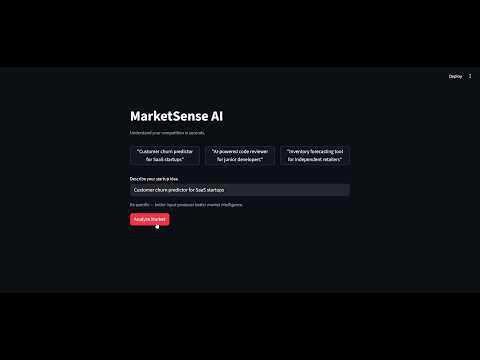
Click to watch the demo
You describe a startup idea. MarketSense finds real competitors, scrapes their websites, and synthesizes it all into a structured comparison table and grounded strategic insights - gap analysis, differentiation angles, and market patterns - with zero hallucination.
No dumping raw search results. No vague summaries. Just structured, machine-readable output you can act on.
Most AI research tools pipe search results straight into an LLM and return unstructured prose. MarketSense treats the LLM as a noisy parser and enforces correctness through deterministic layers:
| Layer | Responsibility |
|---|---|
| Exa Search | Semantic company discovery - categories over keywords |
| LLM (Groq) | Extracts approximate structure from raw website text |
| Pydantic | Enforces schema, coerces malformed output, rejects invalid data |
| Post-process | Overrides LLM confidence scores with signal-based computation; strips marketing claims from features |
| Synthesis | Constrains the LLM to grounded insights - every claim must cite a company name from the input data |
Output is stable and machine-readable across runs. No hallucinated gaps, no floating-point confidence values, no numbered feature arrays.
The pipeline is a series of layers - each one tightening the structure the next layer receives:

Idea (text)
    ↓
Exa Semantic Search           → 8 raw company results
    ↓
LLM Filter (Groq)             → 5 real companies (no blogs, news, directories)
    ↓
URL Quality Filter            → strips review sites, social profiles, noise paths
    ↓
Exa Content Extraction        → full website text per company
    ↓
LLM Analysis (Groq)           → structured JSON per company (name, features)
    ↓
Pydantic Validation           → type coercion, schema enforcement
    ↓
Post-Processing               → confidence recomputed from signals, features deduplicated
    ↓
Synthesis (Groq + Guardrails) → comparison table + grounded insights
    ↓
Streamlit UI                  → rendered output
1. Semantic Search - Exa's category: company filter finds company pages instead of review sites or news articles. Highlights are extracted per result.
2. LLM Filtering - A strict Groq prompt selects at most 5 real companies from the results, discarding blogs, directories, and aggregators.
3. URL Quality Guard - Deterministic rules drop known noise domains (capterra.com, g2.com, linkedin.com, etc.) and generic paths (/about, /contact, /login).
4. Content Extraction - Exa fetches full page text for each remaining URL, capped at 5,000 characters per company.
5. LLM Analysis + Pydantic - Groq extracts a structured company profile (name, summary, target audience, features). Pydantic validates and coerces: float confidence becomes int, feature dicts become string arrays.
6. Post-Processing - The post-process layer overrides two LLM outputs deterministically:
- Confidence is recomputed from content depth, product-signal presence, and URL quality — never from the LLM.
- Features are filtered against a marketing-claim blocklist (
"up to","boost","guaranteed", etc.) and deduplicated by normalized key.
7. Synthesis - A constrained prompt forces the LLM to produce a markdown comparison table and 3–5 insights. Each insight must end with (based on: [company name]) and make a concrete claim. A validation pass discards any insight under 10 words or lacking a company citation.
| Tool | Role |
|---|---|
| Exa | Semantic company search + full-page content extraction |
Groq (llama-3.1-8b-instant) |
LLM inference for filtering, analysis, and synthesis |
| Pydantic v2 | Schema validation and type coercion |
| Streamlit | Frontend and UI |
| python-dotenv | Environment variable management |
marketsense-ai/
├── app.py                  # Streamlit UI + pipeline orchestration
├── services/
│   ├── exa_client.py       # Exa search and content extraction
│   ├── groq_client.py      # Groq LLM calls + Pydantic validation
│   └── synthesis.py        # Market overview synthesis
├── utils/
│   ├── prompts.py          # LLM prompt builders
│   └── post_process.py     # Deterministic confidence + feature cleaning
├── assets/
│   └── architecture.png    # Architecture diagram
├── .env.example
├── requirements.txt
└── README.md
1. Clone and create a virtual environment
git clone https://github.com/sudo-Harshk/marketsense-ai
cd marketsense-ai
python -m venv venv

# macOS/Linux
source venv/bin/activate

# Windows
venv\Scripts\activate
2. Install dependencies
pip install -r requirements.txt3. Configure API keys
cp .env.example .envOpen .env and fill in your keys:
EXA_API_KEY=your_exa_key_here
GROQ_API_KEY=your_groq_key_here
4. Run the app
streamlit run app.pyOpen http://localhost:8501 in your browser.
| Service | Free Tier | Link |
|---|---|---|
| Exa | Yes - 1,000 searches/month | exa.ai |
| Groq | Yes - generous free tier | console.groq.com |
Both services offer free tiers sufficient for development and testing.