



🚀 Getting Started - 📚 Documentation - 💻 User guide
Caution
Alpha software: PyC is currently under active development. Public APIs may change and be unstable between releases.
 PyC is a library built upon
  PyTorch and
  Pytorch Lightning to easily implement interpretable and causally transparent deep learning models.
The library provides primitives for annotated tensors, interpretable layers, interventions, interpretable probabilsitic graphical models, and APIs for running experiments at scale.
Pytorch Lightning to easily implement interpretable and causally transparent deep learning models.
The library provides primitives for annotated tensors, interpretable layers, interventions, interpretable probabilsitic graphical models, and APIs for running experiments at scale.
The name of the library stands for both
- PyTorch Concepts: as concepts are essential building blocks for interpretable deep learning.
-
$P(y|C)$ : as the main purpose of the library is to support sound probabilistic modeling of the conditional distribution of targets$y$ given concepts$C$ .
Install PyC from PyPI:
pip install --pre pytorch-concepts[data]Use pip install --pre pytorch-concepts for core-only (no data dependencies), or see full installation options for conda setup.
After installation, you can import it in your Python scripts as:
import torch_concepts as pycFollow our user guide to get started with building interpretable models using PyC!
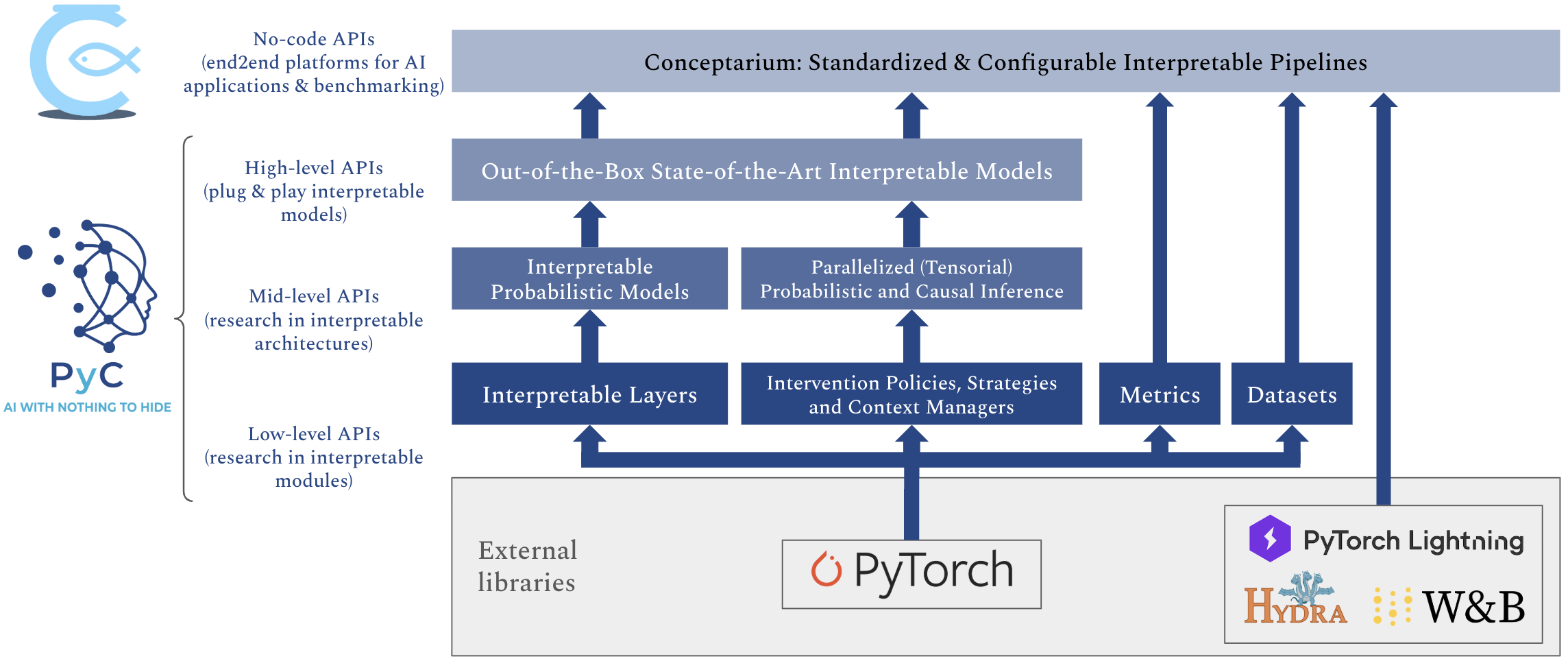
The library is organized to be modular and accessible at different levels of abstraction:
 Conceptarium (No-code API): applications and benchmarking. These APIs allow to easily run large-scale experiments by interfacing only with configuration files. Built on top of
  Hydra and
  WandB.
- High-level APIs: use out-of-the-box models. These APIs allow to instantiate models with 1 line of code. Models are available both as plain PyTorch modules (implementing
forward, allowing custom training loops) and as PyTorch Lightning modules. - Mid-level APIs: interpretable probabilistic graphical models. These APIs allow to define variables (concepts and embeddings), connect them via conditional distributions parametrized by interpretable layers, and perform probabilistic inference on the resulting graphical model.
- Low-level APIs: interpretable layers. These APIs allow to build architectures from basic interpretable layers in a plain PyTorch-like interface. These APIs also include annotated tensors, interventions, metrics, losses, and datasets.
Contributions are welcome! Please check our contributing guidelines to get started.
Thanks to all contributors! 🧡
- Sonia Laguna, ETH Zurich (CH).
- Moritz Vandenhirtz, ETH Zurich (CH).
If you found this library useful for your research article, blog post, or product, we would be grateful if you would cite it using the following bibtex entry:
@software{pycteam2025concept,
    author = {Barbiero, Pietro and De Felice, Giovanni and Espinosa Zarlenga, Mateo and Ciravegna, Gabriele and Dominici, Gabriele and De Santis, Francesco and Casanova, Arianna and Debot, David and Giannini, Francesco and Diligenti, Michelangelo and Marra, Giuseppe},
    license = {Apache 2.0},
    month = {3},
    title = {{PyTorch Concepts}},
    url = {https://github.com/pyc-team/pytorch_concepts},
    year = {2025}
}
Reference authors: Pietro Barbiero, Giovanni De Felice, and Mateo Espinosa Zarlenga.
This project is supported by the following organizations: