








An end-to-end semantic book recommendation system leveraging vector embeddings (sentence-transformers), approximate nearest neighbor search (FAISS), and generative AI (Google Gemini/Vertex AI) for personalized analysis and content generation, wrapped in an interactive Gradio web UI.
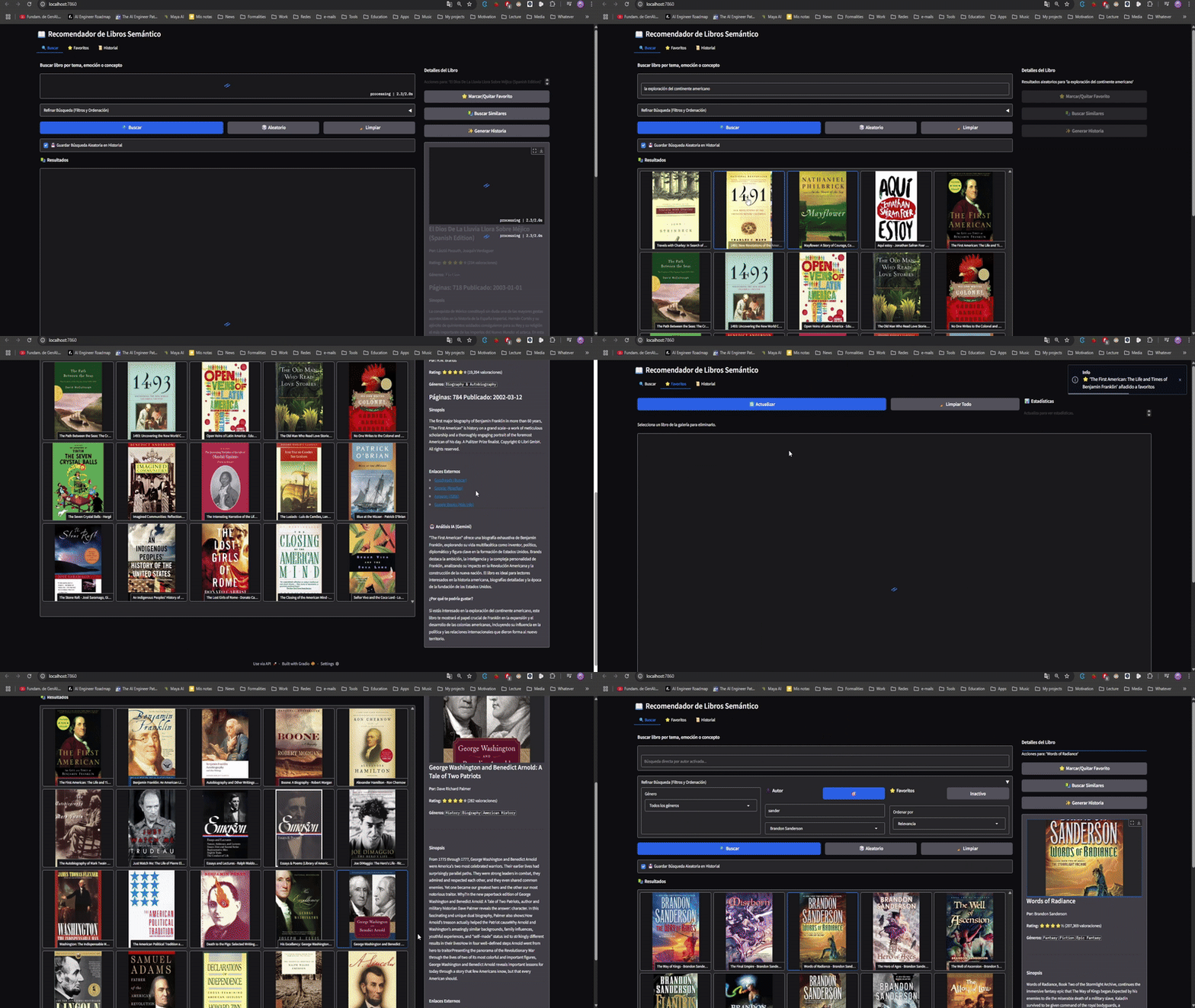
Haz clic en el GIF para ver el video demo completo.
(For a comprehensive architecture overview, data flow diagrams, and UML, please refer to the TECHNICAL_DOCUMENTATION.md)
- Deep Semantic Search: Moves beyond keyword matching by converting natural language queries and book descriptions into high-dimensional vectors using
sentence-transformers. Employs FAISS (CPU) for efficient similarity search (cosine distance) in the vector space, capturing nuanced meaning. - Advanced Filtering & Ranking: Allows users to refine results by genre and author. Provides sorting options based on semantic relevance (vector distance), user rating, popularity (number of ratings), and publication date.
- Interactive UI (Gradio): Offers a reactive web interface built with Gradio, featuring a gallery view for results, detailed book information upon selection, and integrated AI capabilities.
- Persistent User State: Enables users to mark books as Favorites (persisted in
favorites.json) and review their Search History (persisted insearch_history.json), maintaining context across sessions. - AI-Powered Analysis (Google Gemini): Delivers concise, AI-generated book summaries and personalized explanations (
Why you might like this book?) connecting the recommendation to the user's specific query and favorite history, leveraging Google Gemini's reasoning capabilities via LangChain orchestration. - Creative Visual Generation (Google Gemini & Vertex AI): Brings book concepts to life by generating conceptual images and experimental short videos based on plot or themes, utilizing the multimodal capabilities of Google's models.
- Favorite-Influenced Re-ranking: Includes an optional feature (
ENABLE_FAVORITE_BOOSTING) to bias search results towards books similar to the user's favorites, calculated via weighted averaging of query and average favorite vectors. - Efficient Image Handling (
Pillow): Downloads and caches book cover images locally, optimizing UI load times and reducing external dependencies during runtime. - Flexible Configuration (
.env): Centralizes API keys, project IDs, model names, and file paths via environment variables (python-dotenv), promoting security and deployment ease without code modification.
This application adheres to a modular design, promoting separation of concerns, testability, and maintainability. Key architectural components include:
- Semantic Core (
modules/vector_db.py): Encapsulates all logic related to embedding generation (sentence-transformers) and vector storage/search (FAISS). Automatically builds the FAISS index on first run if not found, ensuring ease of setup. FAISS was chosen for its speed on CPU and memory efficiency for medium-sized datasets. - AI Orchestration (
modules/llm_clients.py, LangChain): Provides a unified interface for interacting with Google Gemini (viagoogle-generativeai) and Vertex AI (viagoogle-cloud-aiplatform). LangChain assists in structuring complex prompts for multi-step reasoning, particularly for the personalized AI analysis. - Decoupled Data Management (
modules/data_manager.py): Handles loading, preprocessing (pandas), and access to the core book dataset and user history. Isolates data handling logic from the UI and vector database modules. - Component-Based UI (
modules/ui/*.py, Gradio): Each application tab (Search, History, Favorites) is built as a distinct Gradio module (search_tab.py,history_tab.py, etc.). This promotes independent development and testing of UI sections. - Simple Persistence: User favorites and history are stored in simple JSON/CSV files for easy inspection and portability. The FAISS index is persisted as binary files.
- Centralized Configuration (
modules/config.py): AnAppConfigclass loads settings from.envand defines constants, providing a single source of truth for parameters.
gradio-dashboard.py         # Main application entry point
modules/
├── config.py               # Configuration class (reads .env)
├── data_manager.py         # Handles book data, history
├── image_processor.py      # Image downloading and caching
├── llm_clients.py          # Interface to Gemini/Vertex AI
├── user_preferences.py     # Manages favorites
├── vector_db.py            # FAISS index creation and search
├── ui/                     # Gradio UI modules
│   ├── search_tab.py
│   ├── history_tab.py
│   ├── favorites_tab.py
│   └── components.py       # (Potentially shared UI logic or base class)
└── utils/                  # Utility functions
    ├── text_utils.py
    ├── google_books_client.py
    └── example_queries.py
data/
├── datasets/               # Input CSV dataset(s)
├── vector_db/              # Generated FAISS index files (ignored by Git)
├── images/cached/          # Cached cover images (ignored by Git)
└── user_data/              # User favorites & history (ignored by Git)
assets/                     # Static assets (images, CSS)
requirements.txt            # Python dependencies
TECHNICAL_DOCUMENTATION.md  # In-depth technical docs & UML
README.md                   # This file
.gitignore                  # Specifies intentionally untracked files
.env.example                # Example environment variables file
- UI Framework: Gradio
- Data Handling: Python 3.9+, Pandas
- Vector Embeddings: Sentence-Transformers (via HuggingFace)
- Vector Database: FAISS (CPU)
- AI Models & Orchestration: Google Gemini API, Google Cloud Vertex AI SDK, LangChain
- Image Processing: Pillow
- External APIs: Google Books API
- Dependency Management: Pip, python-dotenv
Prerequisites:
- Python 3.9+
- Git LFS (Recommended, although large files are now ignored, good practice for potential future assets)
- (Optional but Recommended) A virtual environment (
venv,conda)
Steps:
-
Clone the Repository:
git clone https://github.com/ivancastroprojects/semantic-book-recommender.git cd semantic-book-recommender -
Set up Virtual Environment (Recommended):
python -m venv venv
# Linux/macOS: source venv/bin/activate
# Windows: .\venv\Scripts\activate
-
Install Dependencies:
pip install -r requirements.txt
-
Configure Environment Variables:
-
Copy or rename
.env.exampleto.env. -
Edit
.envand add your actual API keys and configuration:# --- REQUIRED for AI features --- GOOGLE_API_KEY="YOUR_GEMINI_API_KEY" # --- REQUIRED for Vertex AI Image Generation (if used) --- VERTEX_PROJECT_ID="YOUR_GCP_PROJECT_ID" VERTEX_LOCATION="us-central1" # Or your preferred region # --- OPTIONAL: Override default models --- # VERTEX_IMAGEN_MODEL_ID="imagegeneration@006" # VERTEX_LLAMA3_MODEL_ID="llama3-70b-instruct" # Example
-
-
Dataset:
- Ensure the
books_with_emotions.csvdataset file is placed in thedata/datasets/directory. - (Add download instructions here if the dataset isn't included).
- Ensure the
-
Run the Application:
python gradio_dashboard.py
- Important Note: The first time you run the application, it will generate the FAISS vector index from the dataset. This process involves downloading the embedding model and processing all book descriptions. It can take several minutes (5-20+ min depending on dataset size and CPU speed). Subsequent launches will be much faster as they load the pre-built index.
- Access the application via the local URL provided in the console (usually
http://127.0.0.1:7860).
Deploying to Hugging Face Spaces is streamlined for Gradio applications:
- Push Code to GitHub: Ensure your latest code is on GitHub, and that
.env,data/vector_db/,data/images/cached/, anddata/user_data/are listed in your.gitignore. - Create a Hugging Face Account.
- Create a New Space:
- Select "Gradio" as the SDK.
- Choose "Clone from GitHub" and provide your repository URL.
- Configure Secrets: In the Space settings ("Settings" -> "Secrets"), add your
GOOGLE_API_KEY,VERTEX_PROJECT_ID, andVERTEX_LOCATIONas secrets. These are crucial for the deployed app's AI features. - Hardware: Start with the free tier (
CPU basic). If index creation is too slow or the app needs more power, consider upgrading.
- Build Process: Hugging Face will clone the repo, install dependencies, and run
gradio_dashboard.py. The initial build will include the FAISS index generation, which can take time. - Access: Once built, your application will be live at the public Space URL.
- Index Creation Time: The initial FAISS index build is the main startup bottleneck. For very large datasets, consider pre-building the index locally and finding a way to upload/load it in the deployment environment (might require paid HF tiers or alternative hosting).
- Embedding Model:
all-MiniLM-L6-v2provides a good balance of speed and quality. Larger, more powerful embedding models exist but would increase index size and potentially slow down search and initial build time. - FAISS Index Type: Currently uses the default
IndexFlatL2(orIndexFlatIPfor cosine). For significantly larger datasets (> millions of vectors), exploring approximate indices likeIndexIVFFlatcould improve search speed at the cost of some accuracy. - API Latency: Calls to external APIs (Gemini, Vertex AI, Google Books) introduce latency. The UI provides some feedback (e.g., "Generating..."), but extensive use might feel slow depending on API responsiveness.
- Gradio Performance: For very high traffic, standard Gradio deployment might require scaling up hardware resources or exploring alternative deployment strategies (e.g., behind a more robust load balancer).
This project serves as a robust foundation. Potential areas for future work include:
- Quantitative Evaluation: Implement metrics (e.g., NDCG, Recall@K) to formally evaluate recommendation quality.
- Advanced Re-ranking: Explore Learning-to-Rank (LTR) models incorporating more user signals.
- Data Enrichment: Integrate APIs like OpenLibrary or Wikidata for richer metadata.
- Scalability: Test and optimize for larger datasets (alternative vector DBs like Milvus/ChromaDB, more efficient FAISS indices).
- UI/UX: Implement result pagination, improved filtering UI, user accounts.
- Testing: Develop comprehensive unit and integration tests.
Contributions are welcome! Please follow standard GitHub practices (Issues, Forks, Pull Requests) for proposing changes.
Distributed under the MIT License. (Create a LICENSE file if one doesn't exist).
Iván Castro Martínez - LinkedIn - GitHub