




From topic to submission-ready manuscript in one command. This pipeline produces a complete, publication-grade systematic literature review article — not a skeleton or reference list, but a real academic manuscript with narrative synthesis, specific clinical data, and full PRISMA 2020 compliance.
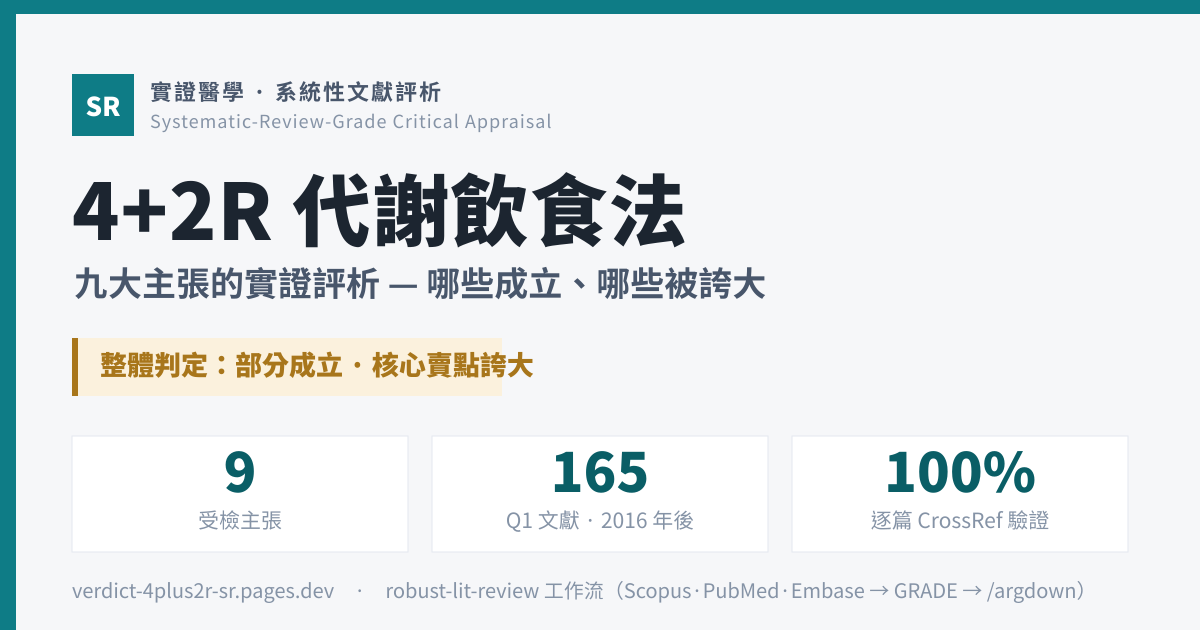
「4+2R 代謝飲食法」實證評析 → — a systematic-review-grade verdict on a popular diet, built end-to-end by
/claim-appraise: 9 claims · 1,056 records → 165 Q1/≥2016/CrossRef-verified studies (97 cited) · GRADE per claim ·/argdown-audited, bilingual 專業/民眾 dual-audience.
Most automated review tools stop at collecting references. This pipeline goes all the way to a submission-ready manuscript with built-in quality assurance:
| What we deliver | How we ensure quality |
|---|---|
| 10,000+ word narrative review | 8 parallel writing agents, each with domain-specific context |
| Specific clinical data (dosing, thresholds, p-values) | Haiku subagent structured extraction from full abstracts |
| Balanced topic coverage | Subtopic-aware article selection across 16 categories |
| Every DOI verified | doi.org handle API validation (100% pass rate) |
| PRISMA 2020 flow diagram | TikZ-rendered professional figure |
| PRISMA 2020 checklist | 27-item self-audit with automated gap detection |
| Auto-repair of gaps | Audit loop dispatches repair agents until all items pass |
| Cover letter to editor | Ready-to-submit letter highlighting significance |
| AMA-formatted citations | CSL-driven superscript numbering |
| PDF + DOCX + BibTeX | Quarto multi-format rendering |
| GitHub Release artifacts | Automated CI/CD on every push |
| Mode | Input | Output | Skill |
|---|---|---|---|
| Topic review | a research topic | submission-ready manuscript (PDF/DOCX) | /lit-review |
| Claim appraisal | a real-world claim | a verdict per sub-question, as a published web report | /claim-appraise |
/claim-appraise "<claim>" turns one real-world claim (a popular diet, a supplement, a health product) into a defensible, peer-checkable evidence appraisal:
- Decompose the claim into PICO sub-questions (efficacy + safety + over-extended claims).
- Per-question systematic review — Scopus + PubMed + Embase, ≥ 2016, Q1 journals only, DOI-validated, and every cited work CrossRef-verified to exist (an anti-hallucination gate — no fabricated citations).
- GRADE the certainty of each sub-question (recomputed deterministically), cross-checked against OpenEvidence.
/argdown-audit the overall verdict logic so the conclusion provably follows.- Ship a verdict-style site (bilingual, 專業/民眾 dual-audience) to Cloudflare Pages, with the claim's primary-source URL attached so peers can confirm no cherry-picking (斷章取義).
Live worked example — the "4+2R 代謝飲食法" diet: https://verdict-4plus2r-sr.pages.dev/
9 sub-claims appraised over 1,056 records → 165 Q1/≥2016/CrossRef-verified studies (97 cited). Verdicts range from 部分成立 (high-protein, meal-order) to 與證據牴觸 (the "重設代謝定點/永不復胖" claim). Reproduce it with scripts/run_4plus2r.py + scripts/build_4plus2r_site.py.
Every run produces a complete submission package:
| File | Purpose |
|---|---|
literature_review.pdf |
The manuscript — ready for journal submission |
literature_review.docx |
Editable Word version for co-author revisions |
cover_letter.qmd |
Cover letter to the editor (auto-generated) |
references.bib |
Validated BibTeX with all DOIs resolved |
sections/09-prisma-checklist.qmd |
Completed PRISMA 2020 checklist (27 items) |
"Hemophagocytic lymphohistiocytosis in adults"
                    |
                    v
    +-----------+----------+-----------+
    |           |          |           |
 Scopus      PubMed     Embase     (parallel)
    |           |          |
    +-----------+----------+
                |
          897 records
                |
          Deduplicate ──> 783 unique
                |
          Quality filter (CiteScore >= 3.0)
                |
          DOI validation (100% via doi.org)
                |
          Fetch full abstracts (PubMed API)
                |
          Balanced subtopic selection ──> 50 articles
                |
          Haiku structured extraction (5 agents)
                |
          Zotero export
                |
    +-----------+--+--+--+--+--+--+--+-----------+
    |  abstract  intro  methods  pathogenesis  ...  |
    |          8 parallel writing agents             |
    +------------------------------------------------+
                |
          PRISMA 2020 audit (27 items)
                |
           pass? ──no──> repair agents ──> re-audit
                |
               yes
                |
          Generate cover letter
                |
          Quarto render (PDF + DOCX)
                |
          GitHub Release
After all sections are written, the pipeline automatically:
- Audits the manuscript against all 27 PRISMA 2020 checklist items (keyword matching or LLM-as-judge via haiku subagents)
- Identifies gaps — items that are missing or partially addressed
- Generates targeted fix instructions for each section file that needs improvement
- Dispatches repair agents that add only the missing content (no rewrites)
- Re-audits until all items pass (max 2 iterations)
from litreview.pipeline.prisma_audit import audit_manuscript, format_audit_report

results = audit_manuscript(Path("output/sections"))
print(format_audit_report(results))
# Score: 35/36 passed (0 failed, 0 partial, 1 N/A)
# All PRISMA 2020 items are addressed. The manuscript is ready for submission.Add --hitl to pause at 9 critical decision points where human judgment is irreplaceable:
/lit-review --hitl "your research topic"
| Checkpoint | When | Why human needed |
|---|---|---|
| CP1 Search Strategy | After query generation | Wrong query = wrong review. Domain expert knows the right terms. |
| CP2 Borderline Articles | After filtering | Articles near the threshold need domain judgment to include/exclude. |
| CP3 Final Article Set | After selection | Expert may know landmark papers the machine missed. |
| CP4 Thematic Grouping | Before writing | How findings are grouped shapes the narrative arc. |
| CP5 Key Claims | After writing | Highest error cost. LLMs can hallucinate dosing, p-values, survival rates. |
| CP6 PRISMA Audit | After audit | Some items may be legitimately N/A for the review type. |
| CP7 Cover Letter | Before render | Target journal selection affects framing. |
| CP8 Final Preview | Before render | Last chance to catch major issues. |
| CP9 Publish Decision | Before push | Public release requires conscious consent. |
Each checkpoint presents multiple-choice options (not open-ended questions), has a default for auto-mode, and logs decisions to checkpoint_log.json for reproducibility.
Without --hitl, the pipeline runs fully automated using defaults.
# Install
uv venv && source .venv/bin/activate && uv pip install -e "."

# Configure API keys
cp .env.example .env
# Edit .env with your API keys

# Run a literature review
lit-review review "your research topic" --target 50 --min-citescore 3.0

# Validate DOIs in existing BibTeX
lit-review validate output/references.bib

# Check API configuration
lit-review check-config| Service | Purpose | Get Key |
|---|---|---|
| Scopus | Article search + CiteScore/SJR metrics | Elsevier Developer Portal |
| PubMed | Biomedical literature search | NCBI API Key |
| Embase | Medical literature (via Elsevier) | Same as Scopus |
| Unpaywall | DOI validation + open access links | Unpaywall (just email) |
| Zotero | Reference management export | Zotero Settings |
The review is written in parallel using Quarto {{< include >}} syntax:
output/
  literature_review.qmd              # Main file with includes
  cover_letter.qmd                   # Letter to the editor
  references.bib                     # BibTeX references
  prisma-flow-diagram/               # PRISMA TikZ package
  sections/
    00-abstract.qmd                  # Structured abstract (~300 words)
    01-introduction.qmd              # Clinical significance, history, objectives
    02-methods.qmd                   # PRISMA flow, search strategy, quality assessment
    03-pathogenesis.qmd              # IFN-gamma axis, cytokines, ferritin, genetics
    04-diagnosis.qmd                 # HLH-2004, HLH-2024, HScore, MAS criteria
    05-etiology.qmd                  # Infections, malignancy, MAS, iatrogenic
    06-treatment.qmd                 # HLH-94 dosing, targeted therapies, HSCT
    07-covid.qmd                     # COVID-19 and HLH paradigm
    08-discussion.qmd                # Synthesis, controversies, future directions
    09-prisma-checklist.qmd          # PRISMA 2020 checklist (27 items, auto-audited)
This is not a template — it's a real article with clinical granularity:
- Diagnostic criteria with exact thresholds: HLH-2004 (8 criteria, 5/8 needed), HScore (cutoff 168, 93% sensitivity, 86% specificity), EULAR/ACR MAS (ferritin >684 + 2/4 criteria)
- Treatment protocols with dosing: etoposide 150 mg/m² twice weekly, dexamethasone 10 mg/m²/day, anakinra 1-2 mg/kg
- Trial data with sample sizes: ZUMA-1 (n=108), CARTITUDE-1 (n=97), emapalumab (n=34, 63% response, P=0.02)
- Every organism named: EBV, CMV, HSV-1/2, HHV-6, HHV-8, HIV, SARS-CoV-2, M. tuberculosis, Ehrlichia, Histoplasma, Plasmodium...
- Distinct entities distinguished: CRS vs IEC-HS vs classical HLH, HLH-2004 vs HLH-2024, MAS vs secondary HLH
On push to main, the workflow automatically:
- Renders Quarto to PDF + DOCX
- Creates a GitHub Release with all artifacts (PDF, DOCX, BibTeX, QMD)
- Uploads artifacts for 90-day retention
This project ships Claude Code skills — type / followed by the skill name to invoke a workflow:
| Slash command | What it does |
|---|---|
/lit-review "topic" |
Full topic→manuscript pipeline (search → filter → write → PRISMA audit → render) |
/lit-review --hitl "topic" |
Same, with 9 human-in-the-loop checkpoints |
/brainstorm-topic |
Brainstorm and refine search terms before running |
/claim-appraise "<claim>" |
Claim appraisal → PICO decomposition → per-question Q1/≥2016/CrossRef-verified SR → GRADE → verdict → bilingual verdict site (see below) |
Skills live in .claude/skills/ and are checked into the repo, so anyone who clones it gets the same / commands.
If you use this pipeline in your research, please cite:
@software{lin2026robustlitreview,
  author       = {Lin, Hsieh-Ting},
  title        = {Robust Literature Review Pipeline: Automated Systematic Review with Multi-Database Search, DOI Validation, and Publication-Ready Output},
  year         = {2026},
  publisher    = {GitHub},
  url          = {https://github.com/htlin222/robust-lit-review},
  version      = {1.0.0}
}Lin, H.-T. (2026). Robust Literature Review Pipeline: Automated systematic review with multi-database search, DOI validation, and publication-ready output (Version 1.0.0) [Computer software]. GitHub. https://github.com/htlin222/robust-lit-review
Lin HT. Robust Literature Review Pipeline: Automated Systematic Review with Multi-Database Search, DOI Validation, and Publication-Ready Output. Version 1.0.0. GitHub; 2026. Accessed March 25, 2026. https://github.com/htlin222/robust-lit-review
See CHANGELOG.md for version history.
MIT