

This package implements an intuitive interface to run and control a csound process
https://csoundengine.readthedocs.io/en/latest/index.html
The core of this package is the Engine class, which wraps a csound
process and allows transparent control over all parameters, while providing
sane defaults. It uses the csound API to communicate with a running csound
instance. All audio processing is run in a separate performance thread.
from csoundengine import *
# create an Engine with default options for the platform.
engine = Engine()

# Define an instrument
engine.compile(r'''
  instr synth
    ; pfields of the instrument
    kmidinote = p4
    kamp = p5
    kcutoff = p6
    kdetune = p7

    kfreq = mtof:k(kmidinote)
    ; A filtered sawtooth
    asig  = vco2:a(kamp*0.7, kfreq)
    asig += vco2:a(kamp*0.7, kfreq + kdetune)
    asig = moogladder2(asig, kcutoff, 0.9)
    ; Attack / Release
    aenv = linsegr:a(0, 0.01, 1, 0.2, 0)
    asig *= aenv
    outs asig, asig
  endin
''')

# Start a synth with indefinite duration. This returns the eventid (p1)
# of the running instrument, which can be used to further control it
event = engine.sched("synth", args=[48, 0.2, 3000, 4])

# Change midinote. setp means: set p-field. This sets kmidinote (p4) to 50
engine.setp(event, 4, 50)

# Modify cutoff
engine.setp(event, 6, 1000, delay=4)

# Create a graphic interface to interact with this event. If running within a jupyter notebook
# a html gui is generated, otherwise a native gui is used:
engine.eventUI(event, p4=(0, 127), p5=(0, 1), kcutoff=(100, 5000))
Each engine can have an associated Session. A Session provides a
higher level interface, allowing to:
- Define instrument templates (an
Instr), which can be instantiated at any order of evaluation, allowing to implement processing chains of any complexity - An
Instrcan have named parameters which can be used to control the event. - A
Sessionprovides a series of built-inInstr's to perform some common tasks, like playing samples from memory or from disk, perform audio analysis, etc.
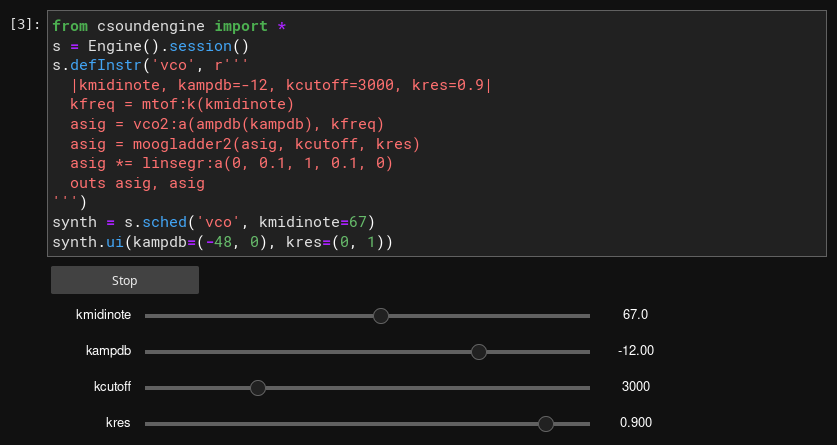
from csoundengine import *

# Create an Engine and a corresponding Session using default options
session = Engine().session()

# or directly create a session, this will launch an engine
session = Session()

# create a master audio bus
masterbus = session.assignBus()

# define instruments
session.defInstr("synth", r'''
  |ibus, kmidi=60, kamp=0.1, ktransp=0, ifade=0.5|
  ; a simple sawtooth
  asig vco2 kamp, mtof:k(kmidi+ktransp)
  asig *= linsegr:a(0, ifade, 1, ifade, 0)
  ; output is routed to a bus
  busout(ibus, asig)
''')

session.defInstr("filter", r'''
  |ibus, imasterbus, kcutoff=1000, kresonance=0.9|
  asig = busin(ibus)
  asig = moogladder2(asig, kcutoff, kresonance)
  busmix(imasterbus, asig)
''')

session.defInstr("master", r'''
  imasterbus = p4
  asig = busin(imasterbus)
  asig compress2 asig, asig, -120, -40, -12, 3, 0.1, 0.01, 0.05
  outch 1, asig
''')

# Start a master instance at the end of the evaluation chain
master = session.sched("master", imasterbus=masterbus, priority=10)

# Launch some notes
for i, midinote in enumerate(range(60, 72, 2)):
    # for each synth, we create a bus to plug it to an effect, in this case a filter
    # The bus will be collected once all clients are finished
    bus = session.assignBus()

    # start time for synth and effect
    start = i * 1

    # Schedule a synth
    synth = session.sched("synth", delay=start, dur=5, kmidi=midinote, ibus=bus)

    # Automate pitch transposition so that it descends 2 semitones over the
    # duration of the event
    synth.automatep('ktransp', [0, 0, dur, -2], delay=start)

    # Schedule the filter for this synth, with a priority higher than the
    # synth, so that it is evaluated later in the chain
    filt = session.sched("filter",
                         delay=start,
                         dur=synth.dur,
                         priority=synth.priority+1,
                         kcutoff=2000,
                         kresonance=0.92,
                         ibus=bus,
                         imasterbus=masterbus)

    # Automate the cutoff freq. of the filter
filt.automatep('kcutoff', [0, 2000, dur*0.8, 500, dur, 6000], delay=start)Both an Engine or a Session have an offline version, OfflineEngine and OfflineSession. In these
cases the csound process is started to render to a soundfile, possibly faster than realtime.
https://csoundengine.readthedocs.io/en/latest/Installation.html
- python >= 3.12
- csound 7 >= 7.0 (csound 6 is supported but it is declared EOL)
Note
csound only needs to be installed previously on windows at the moment, for the other platforms it is installed automatically if not present
pip install csoundenginecsoundengine also needs some csound plugins (https://github.com/csound-plugins/csound-plugins/releases), which are installed automatically if needed.
- csoundengine is used as the audio engine in maelzel