
A production-grade integration of backtest-kit that replaces the default file-based
./dump/persistence with MongoDB as the source of truth and Redis as an O(1) lookup cache, packaged withdocker-composefor one-command deploys.
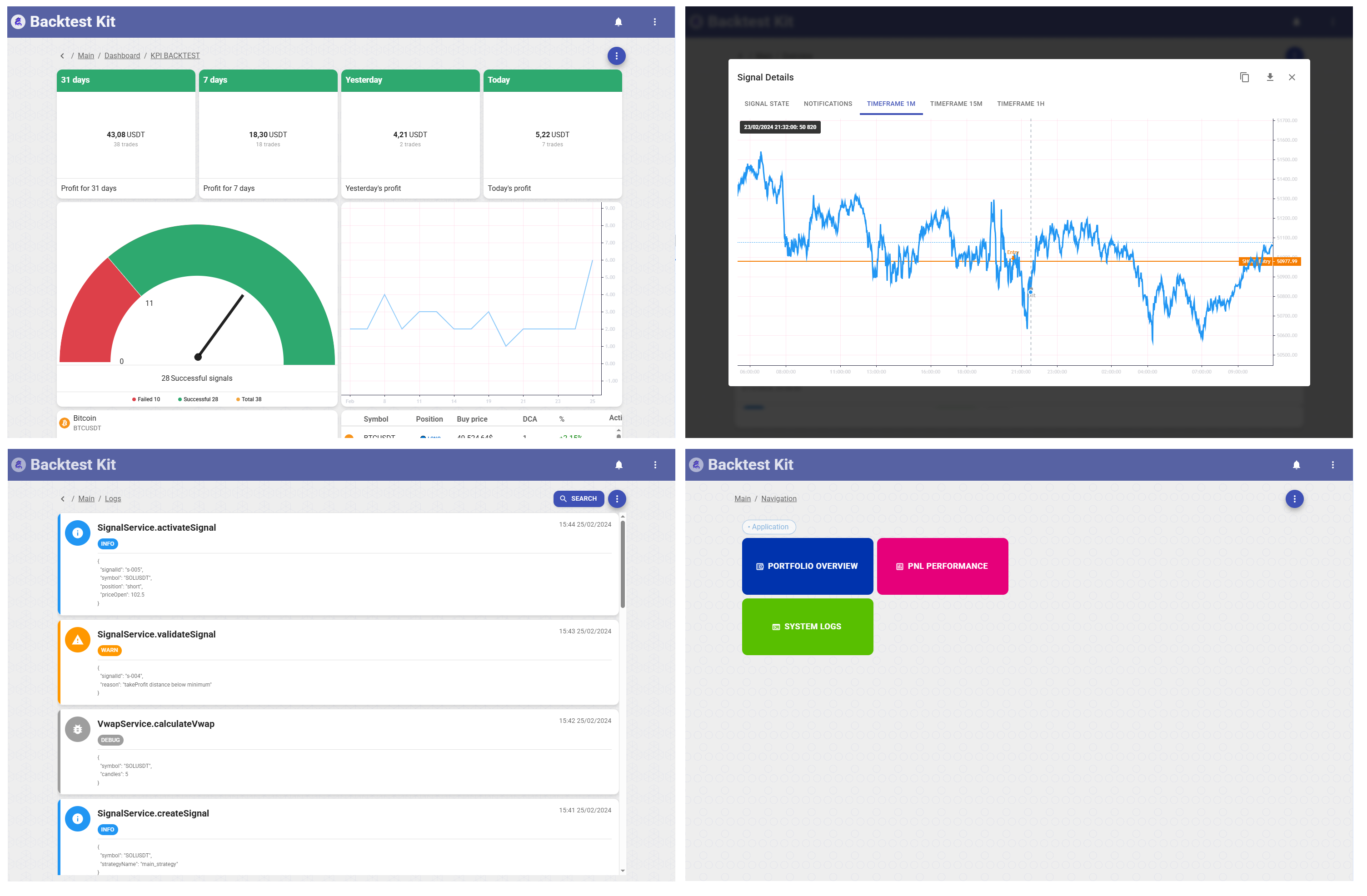




This project ships 15 custom Persist adapters that implement the full backtest-kit IPersist*Instance contract on top of MongoDB + Redis. Strategy code, runners, and the CLI entrypoint stay unchanged — only the persistence layer is swapped.
📚 API Reference | 🌟 Quick Start | 📰 Article
Start MongoDB and Redis in containers:
docker-compose -f docker/mongodb/docker-compose.yaml up -d
docker-compose -f docker/redis/docker-compose.yaml up -d
Run a backtest:
npm run start -- --entry --backtest --ui ./build/index.cjsLive mode:
npm run start -- --entry --live --ui ./build/index.cjsPaper mode:
npm run start -- --entry --paper --ui ./build/index.cjsBundles the strategy, runner, and backtest-kit container together. Reads MODE from env (backtest | live | paper):
MODE=backtest ENTRY=1 UI=1 STRATEGY_FILE=./build/index.cjs docker-compose up -d
docker-compose logs -f
Or via npm script:
npm run start:docker
npm run stop:dockerEach adapter implements the corresponding IPersist*Instance interface from backtest-kit and is registered in src/config/setup.ts. All adapters share the same skeleton:
PersistXAdapter.usePersistXAdapter(class implements IPersistXInstance {
  constructor(/* context fields from backtest-kit */) {}
  async waitForInit(initial: boolean) {
    if (!initial) return;
    await waitForInfra();        // gate first-touch on Mongo + Redis ready
  }
  async readXData(...) { return await ioc.xDbService.findByContext(...); }
  async writeXData(..., when: Date) { await ioc.xDbService.upsert(..., when); }
});| Adapter | Collection | Context key (= unique index) | Purpose |
|---|---|---|---|
| Candle | candle-items |
(symbol, interval, timestamp) |
OHLCV cache; immutable inserts |
| Signal | signal-items |
(symbol, strategyName, exchangeName) |
Live signal state per context |
| Schedule | schedule-items |
(symbol, strategyName, exchangeName) |
Pending scheduled signal |
| Risk | risk-items |
(riskName, exchangeName) |
Active risk positions snapshot |
| Partial | partial-items |
(symbol, strategyName, exchangeName, signalId) |
Partial profit/loss levels per signal |
| Breakeven | breakeven-items |
(symbol, strategyName, exchangeName, signalId) |
Breakeven reached flag |
| Storage | storage-items |
(backtest, signalId) |
Closed/opened signal log per mode |
| Notification | notification-items |
(backtest, notificationId) |
Event notifications |
| Log | log-items |
(entryId) |
Strategy log entries |
| Measure | measure-items |
(bucket, entryKey) |
LLM/API response cache (soft-delete) |
| Interval | interval-items |
(bucket, entryKey) |
Once-per-interval markers (soft-delete) |
| Memory | memory-items |
(signalId, bucketName, memoryId) |
Per-signal memory store (soft-delete) |
| Recent | recent-items |
(symbol, strategyName, exchangeName, frameName, backtest) |
Last public signal per context |
| State | state-items |
(signalId, bucketName) |
Per-signal state buckets |
| Session | session-items |
(strategyName, exchangeName, frameName) |
One session per running strategy |
backtest-kit is designed with a write durability contract: after writeXData(...) returns, the very next readXData(...) must see the just-written value. The default file-based persist satisfies this trivially via fs.writeFile + fs.readFile. A naïve Mongo implementation — findByContext → if existing update else create — does not satisfy this contract under concurrent access: two parallel writers both hit "no existing", both attempt insert, second one crashes with E11000 duplicate key. The framework then re-fetches from the exchange, retries the write, loops forever, or silently corrupts state.
Every upsert in this project goes through a single atomic round-trip to MongoDB:
// from src/lib/services/db/SignalDbService.ts
public upsert = async (symbol, strategyName, exchangeName, payload) => {
  const filter = { symbol, strategyName, exchangeName };  // matches the unique index
  const document = await SignalModel.findOneAndUpdate(
    filter,
    { $set: { payload } },
    { upsert: true, new: true, setDefaultsOnInsert: true },
  );
  const result = readTransform(document.toJSON()) as ISignalRowDoc;
  await this.signalCacheService.setSignalId(result);     // Redis: ctx-key → id
};
Key properties of this pattern:
- Filter shape == unique index shape. Every collection has a Mongoose unique compound index whose fields are exactly the context key fields. MongoDB rejects all but one concurrent insert at the storage engine level — no E11000 leaks to the application.
$setfor mutable fields, never$setOnInsertfor the payload. Subsequent writes to the same context key are updates, not no-ops. The exception isCandleDbServicewhere candles are immutable and use$setOnInsertto preserve the first-written values.new: truereturns the just-mutated document. The id is fed to the Redis cache immediately, so the nextfindByContextis O(1).setDefaultsOnInsert: trueensures Mongoose schema defaults (createDate,updatedDate,removed: false) are applied on insert paths.
For soft-delete operations (Measure, Interval, Memory), a parallel atomic pattern is used:
public softRemove = async (bucket, entryKey) => {
  const document = await IntervalModel.findOneAndUpdate(
    { bucket, entryKey },
    { $set: { removed: true, "payload.removed": true } },
    { new: true },
  );
  if (document) await this.intervalCacheService.setIntervalId(...);
};
The document is never physically deleted — listKeys filters on removed: false to skip tombstones. This mirrors the soft-delete semantics of the default file-based PersistMeasureInstance / PersistIntervalInstance / PersistMemoryInstance (Persist.ts:3304).
MongoDB queries on an indexed compound key are fast (O(log n) on the B-tree), but backtest-kit performs thousands of read-by-context-key per second during backtests. Redis turns that into O(1) lookups.
For each domain there is a *CacheService that extends BaseMap (src/lib/common/BaseMap.ts) — a thin wrapper around ioredis that gives a string-keyed map API (get, set, delete, has, keys, values, toArray, iterate, size) on top of Redis keys namespaced by a service prefix.
// src/lib/services/cache/SignalCacheService.ts
const REDIS_KEY = "signal_cache";

export class SignalCacheService extends BaseMap(REDIS_KEY, -1) {  // -1 = no TTL
  private _cacheKey(symbol, strategyName, exchangeName) {
    return `${exchangeName}:${strategyName}:${symbol}`;
  }
  public async getSignalId(symbol, strategyName, exchangeName) {
    return <string>await super.get(this._cacheKey(...)) ?? null;
  }
  public async setSignalId(row) {
    await super.set(this._cacheKey(row.symbol, row.strategyName, row.exchangeName), row.id);
    return row.id;
  }
}public findByContext = async (symbol, strategyName, exchangeName) => {
try {
const cachedId = await this.signalCacheService.getSignalId(...);
if (cachedId) return await super.findById(cachedId); // ← O(1) Redis + O(1) Mongo by _id
} catch { void 0; }
// Cache miss: fall back to Mongo by full filter, then backfill Redis.
const result = await super.findByFilter({ symbol, strategyName, exchangeName });
if (result) await this.signalCacheService.setSignalId(result);
return result;
};- Cache hit (steady state): one Redis
GET+ one MongofindById(_id)— both O(1) - Cache miss (cold start, eviction, Redis restart): one Mongo
findOneby indexed filter + one RedisSETto backfill - After
upsert: the cache is updated synchronously in the same critical section, so the nextfindByContextalways hits the cache
backtest-kit 9.0+ added a when: Date argument to every adapter write* method (and to read* for adapters that affect signal logic: Risk, Partial, Breakeven). The argument carries the logical simulation timestamp at which the write happens.
For adapters that touch signal-affecting state (Risk, Partial, Breakeven, Recent, State, Session, Memory, Interval), the corresponding Mongoose schema has an indexed when: Number column:
// src/schema/State.schema.ts
const StateSchema = new Schema({
  signalId: { type: String, required: true, index: true },
  bucketName: { type: String, required: true, index: true },
  payload: { type: Schema.Types.Mixed, required: true },
  when: { type: Number, required: true, index: true },  // ms since epoch
});
The DbService converts Date → ms and stores it via $set on every upsert:
public upsert = async (signalId, bucketName, payload, when) => {
  const document = await StateModel.findOneAndUpdate(
    { signalId, bucketName },
    { $set: { payload, when: when.getTime() } },
    { upsert: true, new: true, setDefaultsOnInsert: true },
  );
  // ...
};
This lets backtest-kit's internal look-ahead-bias filter (which lives upstream of the adapter) verify that no read returns a value with when > current_simulation_time. Measure is intentionally exempt — it caches LLM responses where look-ahead bias is not applicable.
docker/
  mongodb/docker-compose.yaml   # mongodb:8.0.4 on :27017, volume ./mongo_data
  redis/docker-compose.yaml     # redis:7.4.1 on :6379, password=mysecurepassword
docker-compose.yaml             # main: backtest-kit container, mounts project as /workspace
The main docker-compose.yaml uses extra_hosts: host.docker.internal:host-gateway so the container reaches MongoDB and Redis on the host machine. Use host.docker.internal instead of 127.0.0.1 in your connection strings, or override via .env if your infrastructure runs elsewhere:
CC_MONGO_CONNECTION_STRING=mongodb://prod-mongo:27017/backtest-pro
CC_REDIS_HOST=prod-redis
CC_REDIS_PORT=6379
CC_REDIS_USER=default
CC_REDIS_PASSWORD=...
Container env vars consumed by @backtest-kit/cli:
| Var | Purpose |
|---|---|
MODE |
backtest | live | paper |
STRATEGY_FILE |
Path to compiled strategy bundle (default: ./build/index.cjs) |
ENTRY |
Set to 1 to actually run (matches --entry flag in CLI mode) |
SYMBOL, STRATEGY, EXCHANGE, FRAME |
Override strategy context |
UI |
Enable web UI on :60050 |
TELEGRAM, VERBOSE, NO_CACHE, NO_FLUSH |
Standard backtest-kit CLI flags |
Healthcheck pings http://localhost:60050/api/v1/health/health_check every 30s.
The actual trading logic lives outside the persistence layer — see src/logic/strategy/ and src/logic/frame/ for examples, and modules/ for the ccxt exchange adapter registration. Mode-specific entry points in src/main/ gate on CLI args from src/helpers/getArgs.ts:
// src/main/backtest.ts
const main = async () => {
  const { values } = getArgs();
  if (!values.entry || !values.backtest) return;

  await ioc.mongoService.waitForInit();
  await ioc.redisService.waitForInit();
  await waitForReady(true);

  await warmCandles({ exchangeName: ExchangeName.CCXT, /* ... */ });

  Backtest.background("TRXUSDT", {
    exchangeName: ExchangeName.CCXT,
    frameName: FrameName.Jan2026Frame,
    strategyName: StrategyName.Jan2026Strategy,
  });
};