


Computer Science undergraduate at Delhi Technological University (DTU) passionate about Artificial Intelligence, Distributed Systems, Competitive Programming, and Software Engineering.
I enjoy solving algorithmic challenges, building intelligent systems, and applying AI to real-world problems through hands-on projects. I believe in learning by building and continuously exploring new technologies.
An adaptive, two-way knowledge twin that uses temporal RAG to track how Elon Musk’s documented knowledge evolves instead of merely imitating his personality.
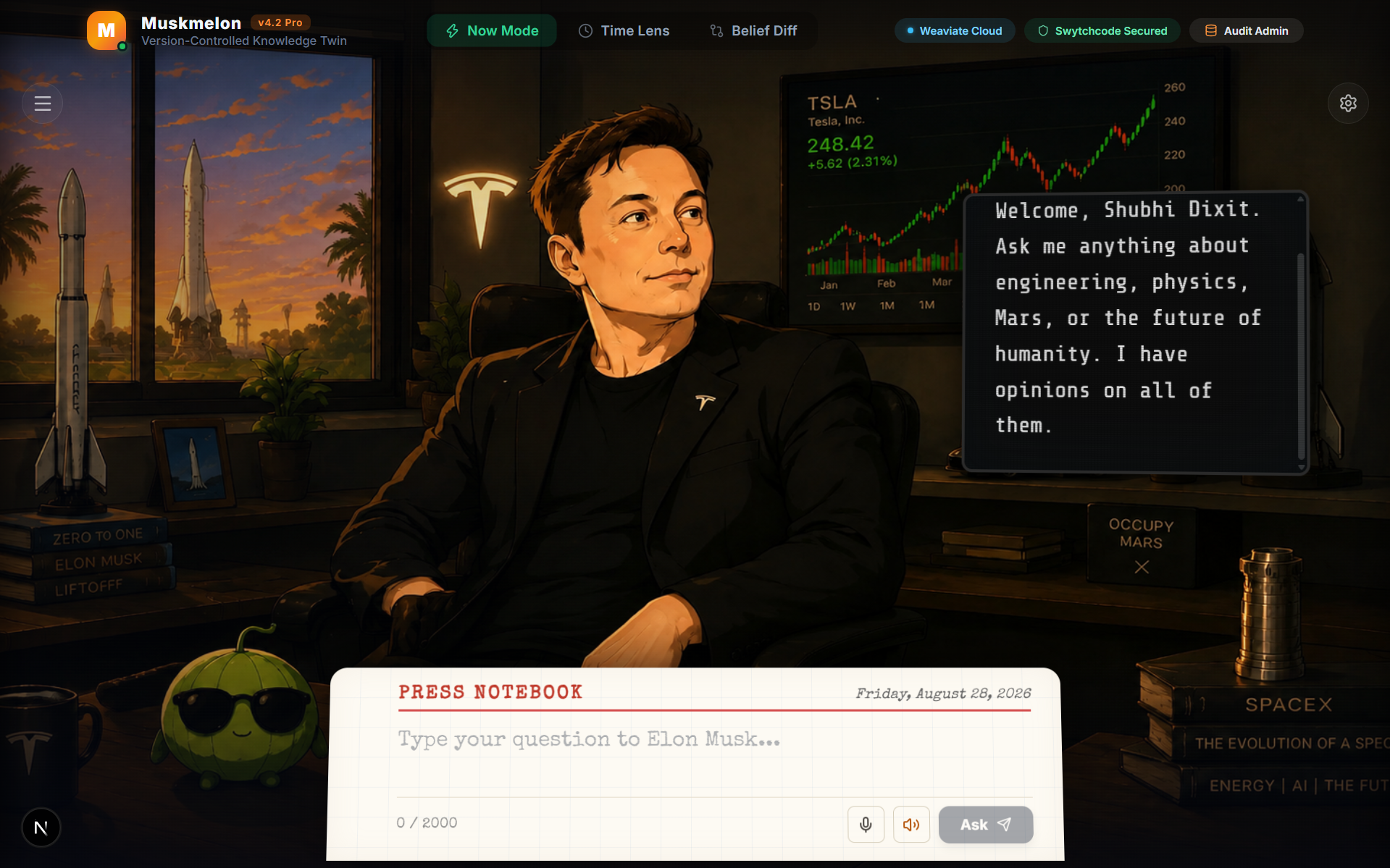
User Query → Temporal Query Planning → Context Capsule → Weaviate Retrieval → Evidence-Grounded Generation → Grounding Gate → Answer Receipt
- Converts dated statements, interviews and roadmap documents into traceable Knowledge Commits with temporal and provenance metadata.
- Supports Now Mode, Time Lens and Belief Diff to reveal current positions, reconstruct historical knowledge and compare belief shifts across periods.
- Produces Answer Receipts containing supporting sources, dates, contradictions, evidence coverage and grounding confidence.
- Enforces a Knowledge–Voice Firewall that prevents persona style from introducing unsupported factual claims.
- Reuses relevant evidence through a compact Context Capsule, improving follow-up continuity while reducing repeated retrieval and token usage.
- Maintains a separate, consent-based User Twin to personalise explanation depth and tone without changing historical evidence.
- Routes Google Drive ingestion, Weaviate retrieval and LLM generation through Swytchcode for policy-controlled and auditable execution.
- Secured 4th place among 108 teams in Round 2 of VibeWright at Oblivion’26, after advancing from 200+ Round 1 teams.
View architecture
flowchart LR
    U["User query"] --> T["Temporal planner"]
    T --> C["Context Capsule"]
    C --> S["Swytchcode"]
    S --> W["Weaviate retrieval"]
    W --> E["Evidence Pack"]
    E --> L["LLM + User Twin"]
    L --> G["Grounding Gate"]
    G --> A["Answer Receipt"]
Next.js • React • TypeScript • Node.js • Temporal RAG • Weaviate Cloud • OpenAI • Swytchcode • Google Drive
Built for the VibeWright Hackathon at Oblivion’26, NSUT.
Repository: MuskMelon
A browser-based rescue command center that simulates leaderless drone coordination when communication networks and disaster infrastructure become unreliable.
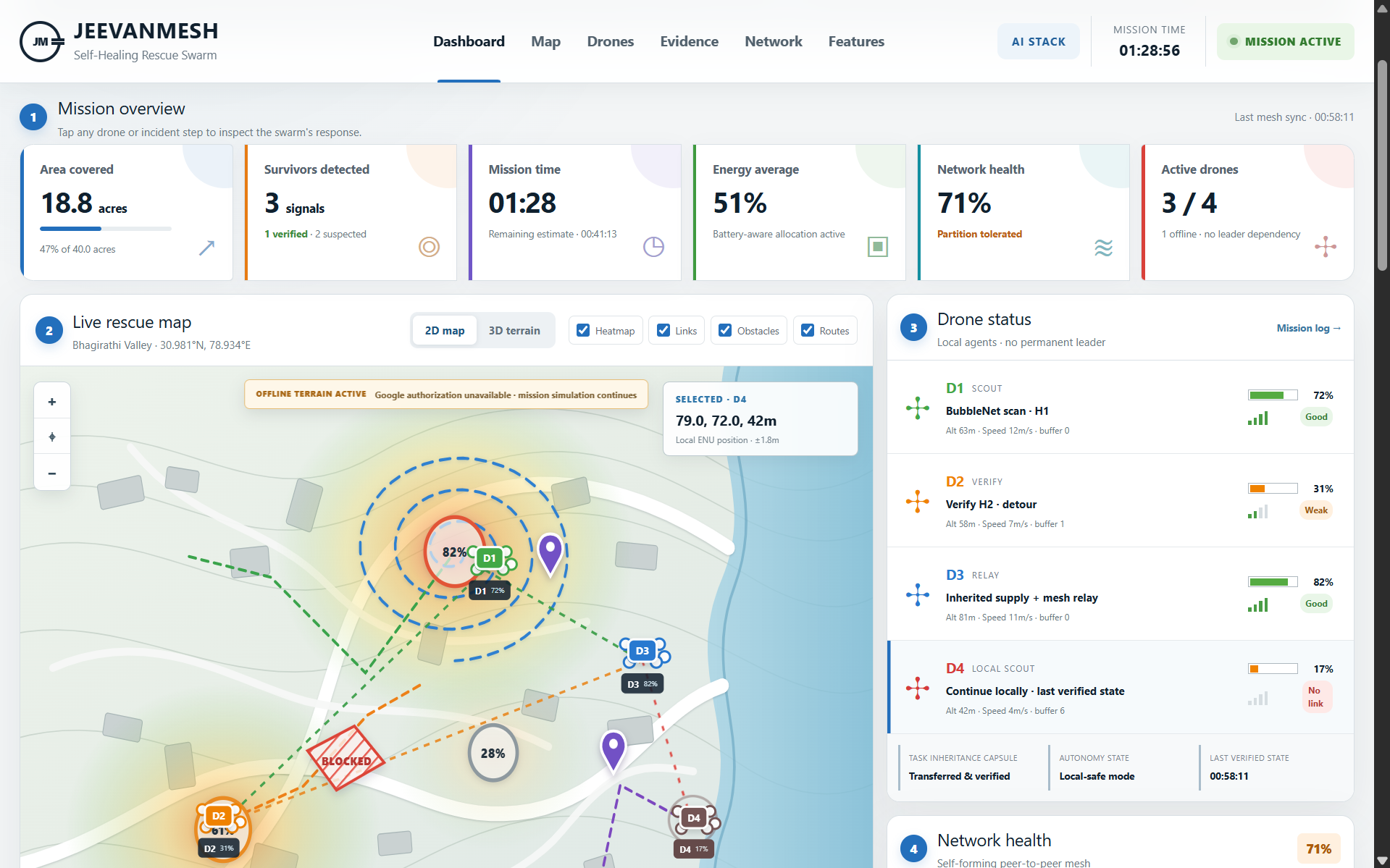
Disaster Mission → Local Drone Agents → BubbleNet Search → Evidence + Uncertainty Map → Role Reallocation → Store–Carry–Forward Mesh → Human Safety Checkpoint
- Models a leaderless, partition-tolerant swarm in which losing one drone or communication link does not stop the rescue mission.
- Allows drones to switch between scout, verifier, communication-relay and supply roles according to mission priority, connectivity and battery state.
- Implements BubbleNet Adaptive Search, a whale-inspired confidence-driven spiral that reduced target-discovery time by 39.7% over grid scanning in the controlled prototype scenario.
- Uses Firefly Relay Positioning to score potential relay locations from connectivity gain, survivor priority and energy cost, enabling temporary agents to repair the mesh.
- Preserves discoveries and tasks through Search–Remember–Recover and store–carry–forward communication, synchronising buffered information after reconnection.
- Represents survivor detections using confidence, source and recency; conflicting reports request another observation instead of being presented as confirmed truth.
- Visualises drone movement, 3D coordinates, mesh links, survivor heatmaps, battery-aware task inheritance, blocked-route rerouting and JeevanLink civilian connectivity.
- Includes a repeatable network-failure demonstration and human approval checkpoint for high-risk rescue recommendations.
View architecture
flowchart TD
    M["Disaster mission"] --> S["Leaderless drone swarm"]
    S --> P["Local perception + uncertainty map"]
    S --> R["Role, battery + relay manager"]
    P --> B["BubbleNet adaptive search"]
    R --> F["Firefly relay positioning"]
    B --> C["Store–carry–forward synchronisation"]
    F --> C
    C --> H["Human safety checkpoint"]
Next.js • React • TypeScript • Google Maps JavaScript API • Vite • Multi-Agent Simulation • Distributed Systems
Repository: JeevanMesh
A local-first legal assistance system that turns an English, Hindi or Hinglish grievance into grounded legal information, actionable procedures and draft documents.
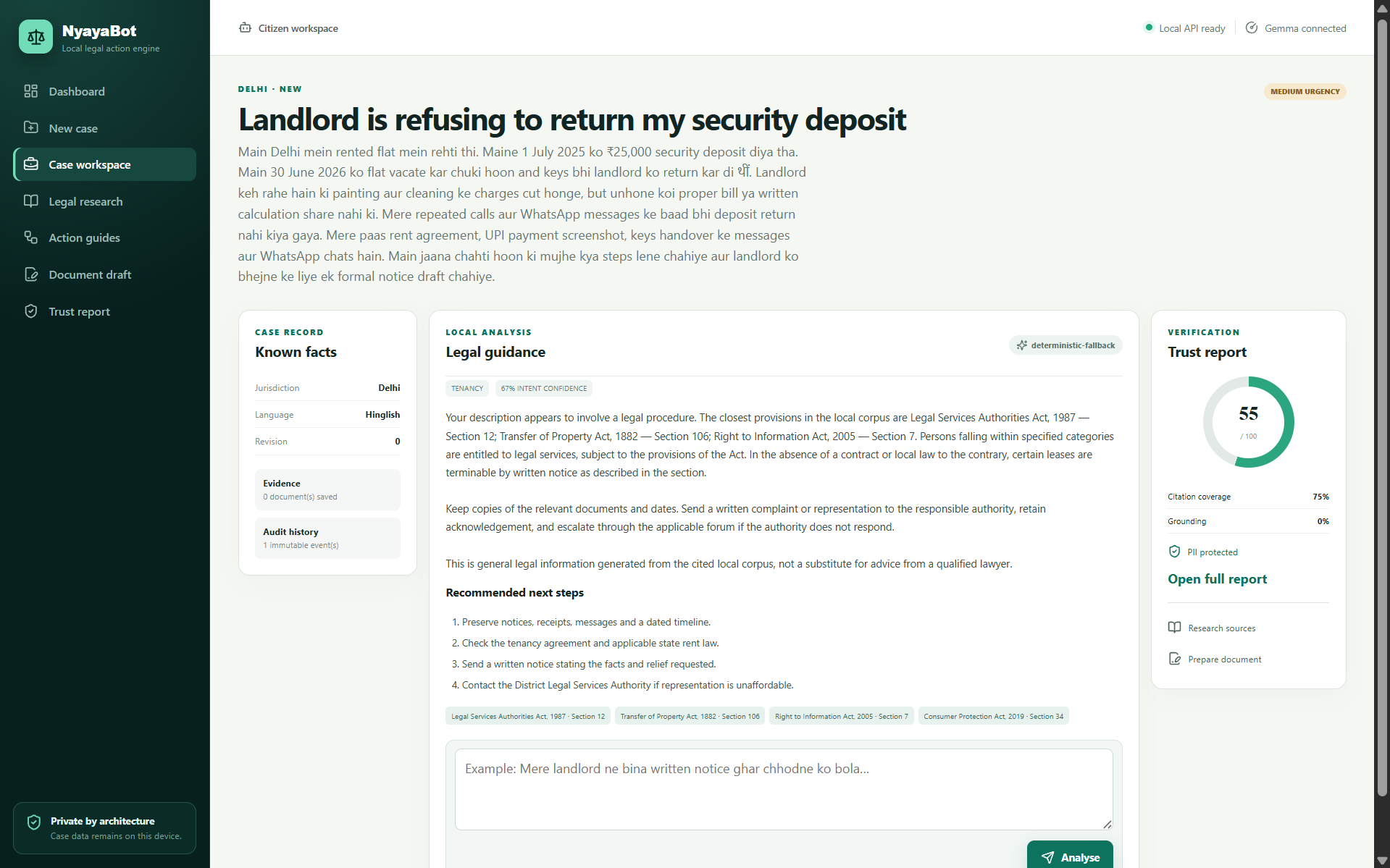
React UI → FastAPI → ShieldAI Input Guards → Hierarchical Legal Retrieval → Tool Workflow → Optional Gemma → Output Verification → SQLite Audit Trail
- Uses hierarchical offline retrieval to identify the relevant legal domain before narrowing the result to supporting provisions.
- Combines local TF-IDF retrieval with an optional Ollama/Gemma layer; a deterministic fallback keeps core workflows usable without the model.
- Applies ShieldAI checks for prompt-injection patterns, configured PII masking, citation presence, grounding and mandatory legal disclaimers.
- Produces practical outputs including procedure checklists, evidence records, case actions and downloadable legal-document drafts.
- Coordinates statutory search, procedure lookup, evidence handling, drafting and verification through a structured tool-driven workflow.
- Stores cases and actions in SQLite with explicit transactions, idempotency validation and compare-and-swap updates for conflict-safe writes.
- Records validation results and execution history so each answer remains traceable rather than appearing as an unexplained model response.
View architecture
flowchart LR
    U["Citizen query"] --> UI["React UI"]
    UI --> API["FastAPI"]
    API --> IN["ShieldAI input checks"]
    IN --> RG["Hierarchical retrieval"]
    RG --> WF["Legal tools + optional Gemma"]
    WF --> OUT["Citation + safety checks"]
    OUT --> DB["SQLite audit trail"]
    DB --> UI
React • TypeScript • Python • FastAPI • SQLite • TF-IDF • Ollama • Gemma • ReportLab • Pytest
Built for the Build with Gemma Hackathon, AIMS-DTU.
Repository: NyayaBot + ShieldAI
An AI decision-support system for rural wool entrepreneurs that compares selling and processing choices using buyer evidence, real costs, constraints and uncertainty instead of giving generic advice.
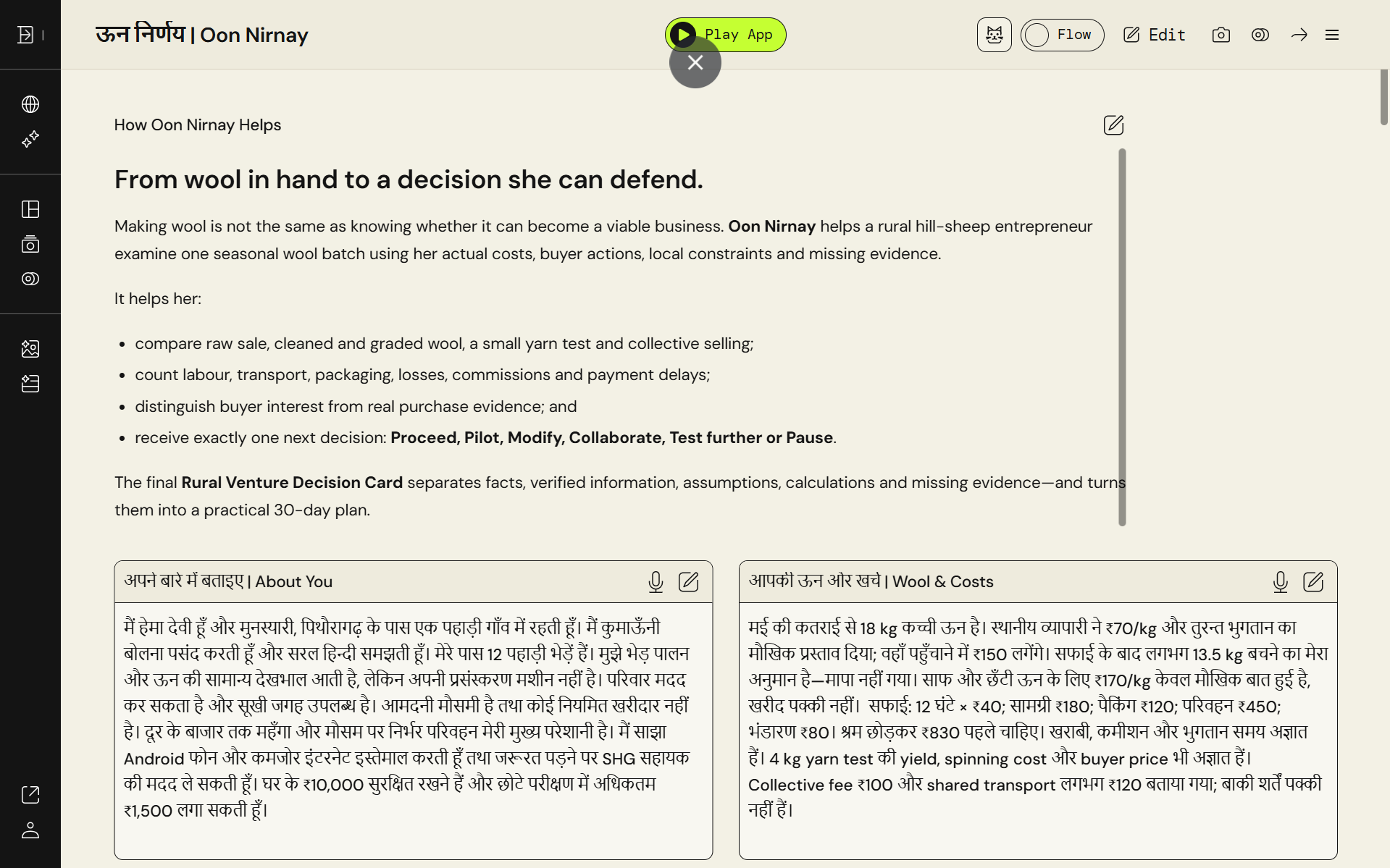
User Situation + Wool Batch → Buyer Evidence → Cost + Constraint Analysis → Missing-Evidence Check → Option Comparison → Explainable Recommendation
- Compares raw sale, cleaned/graded wool, yarn pilots and collective selling using buyer offers, processing yield, labour, transport, packaging, storage and immediate cash constraints.
- Separates verified buyer actions from assumptions, highlights missing evidence and accounts for seasonal and biological risks before recommending a path.
- Produces an explainable numerical cost–benefit breakdown rather than a black-box answer, making the reasoning behind each recommendation visible.
- Uses a multi-widget LLM workflow to combine situation context, wool economics, buyer evidence, flock condition and language preference into one decision.
- Supports simple Hindi/Kumaoni-aware communication, uncertainty-aware outputs and responsible-AI guardrails for users with limited access to reliable market information.
AWS PartyRock • Generative AI • LLMs • Prompt Engineering • Multi-Widget AI Workflow • Responsible AI
Built for the Women Who Master Hackathon.
Live App: Oon Nirnay
A full-stack scheduling platform that converts academic requirements into conflict-checked, preference-aware university timetables.
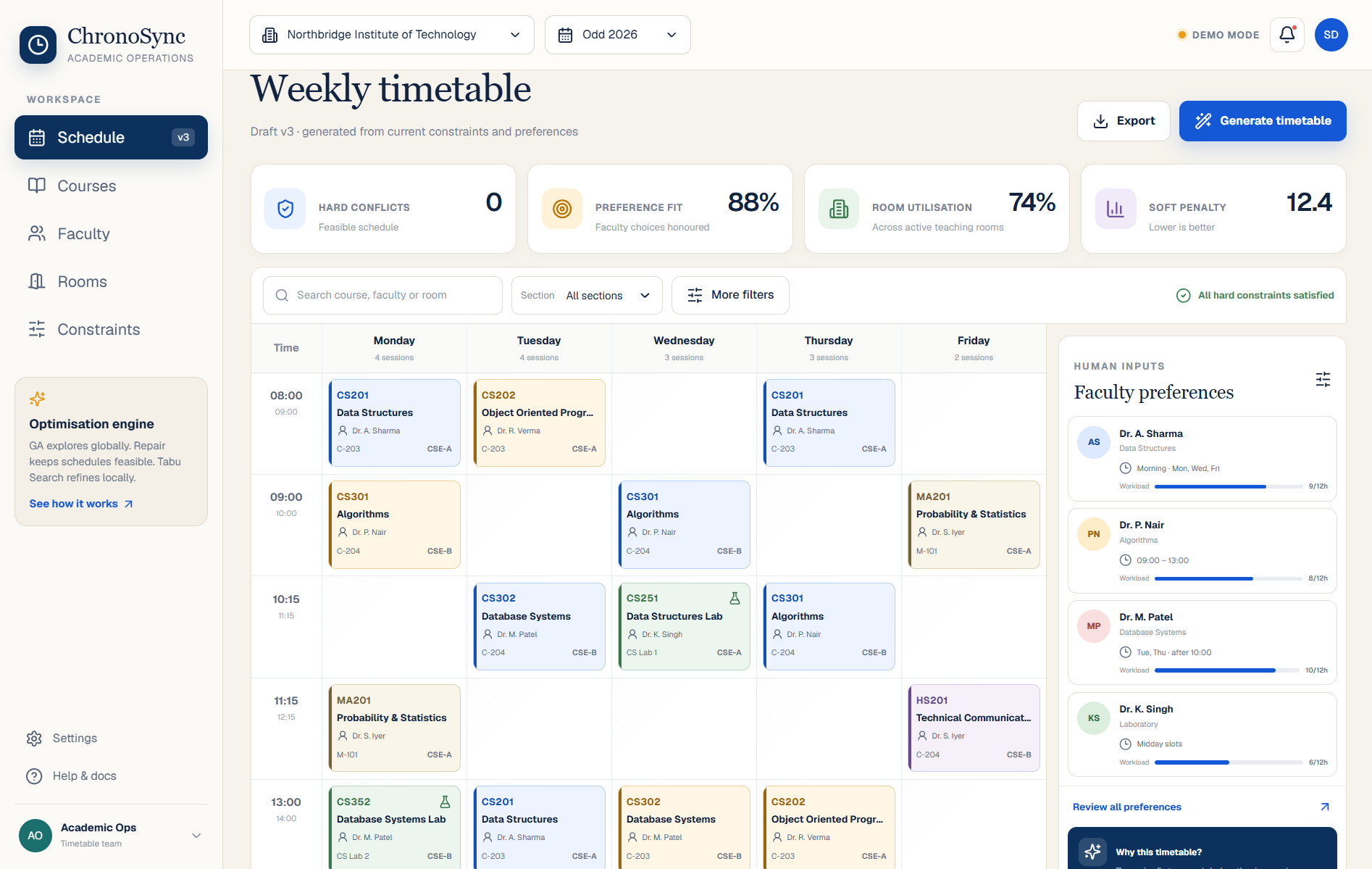
Next.js UI → FastAPI + Pydantic → Genetic Algorithm → Feasibility Repair → Tabu Search → Validated Timetable + Metrics
- Models university timetabling as an NP-hard combinatorial optimisation problem involving courses, faculty, rooms, laboratories, student groups and time slots.
- Separates hard constraints—such as faculty, room and student-group clashes—from soft objectives such as preferences and schedule quality.
- Uses a Genetic Algorithm to explore the global search space, followed by deterministic repair to remove remaining infeasibilities.
- Applies Tabu Search as a local-improvement stage to refine feasible schedules without repeatedly revisiting recent solutions.
- Returns generated timetables with conflict reports, warnings, fitness values and convergence information, making optimisation behaviour explainable.
- Provides typed validation, sample-data, generation and health APIs through FastAPI and Pydantic.
- Includes an interactive TypeScript dashboard for filtering, resource views, generation controls and optimisation metrics.
- Packages the frontend and optimisation service with Docker Compose for reproducible local execution.
View architecture
flowchart LR
    U["Academic inputs"] --> UI["Next.js UI"]
    UI --> API["FastAPI + Pydantic"]
    API --> GA["Genetic Algorithm"]
    GA --> RP["Feasibility repair"]
    RP --> TS["Tabu Search"]
    TS --> VL["Constraint validation"]
    VL --> UI
Next.js • React • TypeScript • Python • FastAPI • Pydantic • Genetic Algorithms • Tabu Search • Docker
Repository: ChronoSync
A software-first runtime that converts natural-language goals into planned, permissioned and verified software actions.
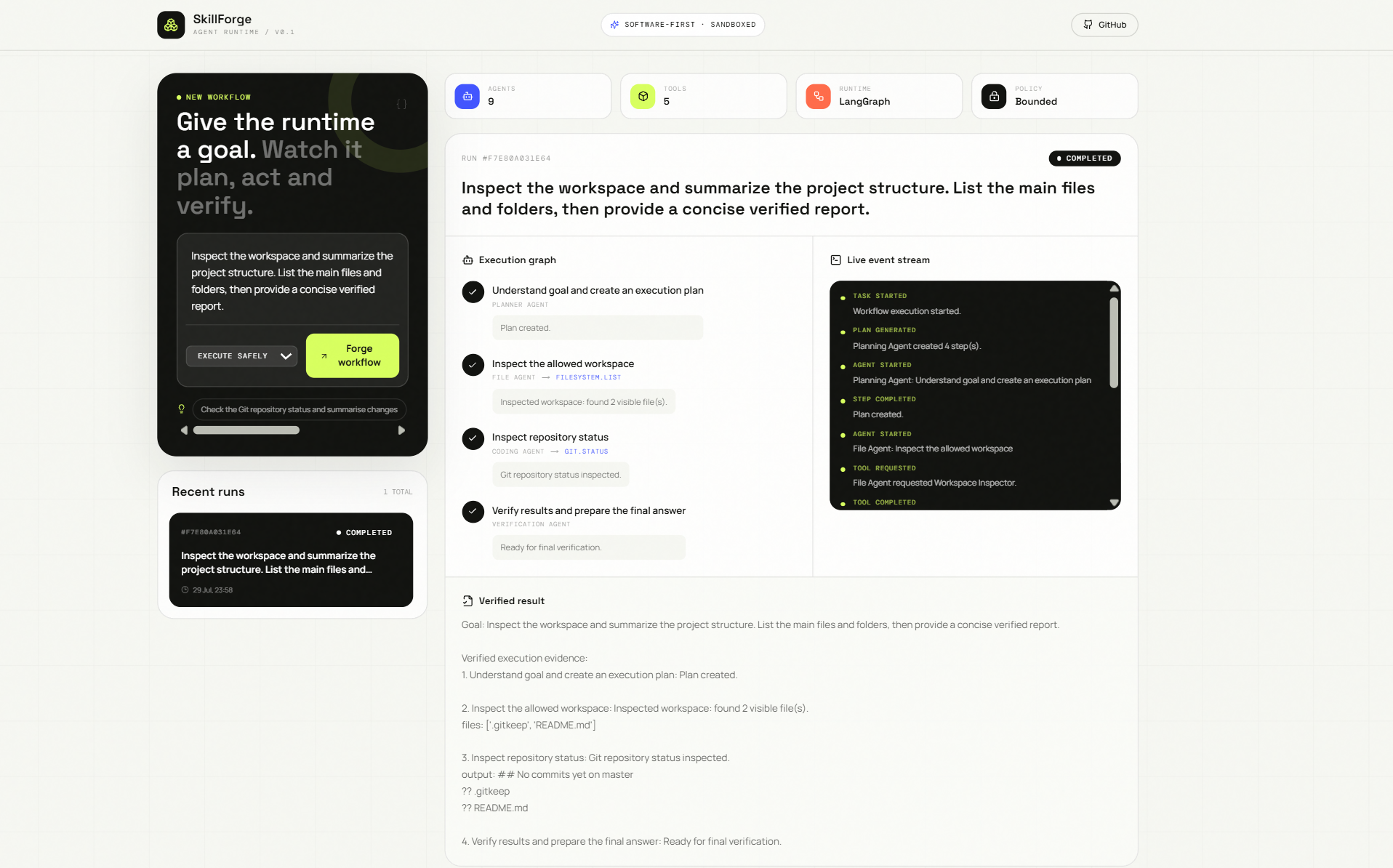
Next.js Dashboard → FastAPI → LangGraph Orchestrator → Specialised Agents → Bounded Tools → Verification → SQLite + Live SSE Events
- Models each task as a stateful plan → execute → verify workflow rather than returning a single chatbot response.
- Routes steps across planning, coding, file, memory, execution and verification roles using central agent and tool registries.
- Executes workspace inspection, safe file reads, Git status, memory search and allow-listed test commands through a permissioned executor.
- Prevents path traversal and unrestricted shell access using workspace boundaries, command allow-lists, timeouts and output limits.
- Streams persisted workflow events to the dashboard using Server-Sent Events, making every step, failure and result observable.
- Works in deterministic zero-key mode, with optional local Gemma through Ollama for evidence-grounded final synthesis.
- Redesigns an initially hardware-dependent robotics concept as an environment-independent runtime; ROS2, Gazebo and physical devices remain future adapters.
View architecture
flowchart LR
    U["Natural-language goal"] --> UI["Next.js UI"]
    UI --> API["FastAPI"]
    API --> LG["LangGraph"]
    LG --> AG["Specialised agents"]
    AG --> EX["Policy-bound executor"]
    EX --> TL["Files · Git · Tests · Memory"]
    TL --> VR["Verification"]
    VR --> UI
Next.js • React • TypeScript • Python • FastAPI • LangGraph • SQLite • SSE • Ollama • Docker • Pytest
Repository: SkillForge
- Machine Learning and Deep Learning
- Computer Vision
- Retrieval-Augmented Generation
- Agentic and Multi-Agent AI
- Responsible and Evidence-Grounded AI
- Fault-Tolerant Systems
- Decentralised Coordination
- Store–Carry–Forward Networks
- Event Synchronisation
- Human-in-the-Loop Autonomy
- Dynamic Programming
- Graph Algorithms
- Trees and Binary Search
- Sliding Window and Two Pointers
- Greedy Algorithms
C++ • Python • TypeScript • JavaScript
Next.js • React • HTML • CSS
FastAPI • Node.js • Express.js
SQLite • MongoDB • Weaviate
LangGraph • OpenCV • TF-IDF • RAG • Ollama • Gemma • Generative AI • LLMs • Prompt Engineering
Data Structures and Algorithms • Object-Oriented Programming • Operating Systems • Distributed Systems
Git • GitHub • Docker • REST APIs • Google Maps API • Server-Sent Events
I regularly practise Competitive Programming to strengthen algorithmic problem-solving and the ability to design efficient solutions under time constraints.
- LeetCode: 100+ problems solved
- Codeforces: 50+ problems solved
- 99.08 Percentile in JEE Main
- Qualified JEE Advanced
- 1st Place – Guessapalooza, IEEE DTU INVICTUS Annual Technical Fest (₹3,000 cash prize)
- 2nd Place – State-Level Mental Mathematics Competition (₹10,500 cash prize)
- Rank 12 – MVPP Delhi State Scholarship Examination among 20,000+ participants (₹5,000 scholarship)
- Strengthening problem-solving through Data Structures and Algorithms and Competitive Programming.
- Studying Machine Learning, Deep Learning, Generative AI, RAG and Multi-Agent AI through hands-on projects.
- Exploring fault-tolerant autonomous systems, temporal reasoning and evidence-grounded AI.